
|
受注:045-509-1970 |
技術サポート:tech@selleck.co.jp 平日9:00〜18:00 1営業日以内にご連絡を差し上げます |
生物学的記述
| Specificity | TBK1/NAK Antibody [C14L9] detects endogenous levels of total TBK1/NAK protein. |
|---|---|
| Background | TBK1 (TANK-binding kinase 1, NAK), a serine/threonine kinase of the IKK-related family alongside IKKε, integrates diverse innate immune signals as a central hub converging cytosolic DNA/RNA sensing with inflammatory transcription across myeloid cells, fibroblasts, and epithelial barriers. It features an N-terminal kinase domain, central scaffold/dimerization region, and C-terminal ubiquitin-binding TBK1/IKKi coiled-coil domain that licenses trans-autophosphorylation at Ser172 upon recruitment to adaptors like STING, MAVS, or TRIF. Ligand-induced clustering, such as cyclic dinucleotides binding STING—recruits TBK1 dimers via specific pLxIS motifs, triggering K48/K63-linked polyubiquitination that relieves autoinhibition and enables sequential phosphorylation of IRF3/7 at multiple serines for dimerization, nuclear translocation, and type I interferon induction; parallel IKK complex activation via NEMO/RelA sustains NF-κB-driven cytokine production while TBK1 phosphorylates STAT6 for chemokine expression and OPTN for selective autophagy of cytosolic pathogens. This dual output coordinates immediate antiviral states with adaptive recruitment, as TBK1 phosphorylates p62 for aggresome clearance and mTORC1 components to balance metabolic reprogramming during infection. TBK1 orchestrates antiviral defense in dendritic cells, limits immunopathology through negative feedback via TANK/Optineurin sequestration, and maintains barrier integrity in lung epithelia, making it the preferred readout for researchers assaying cytosolic sensing fidelity via phospho-IRF3 westerns or CRISPR organoids challenged with cGAMP. Loss-of-function mutations cause hereditary spirochetosis and immunodeficiency, while somatic amplification drives KRAS-mutant lung cancer survival through YAP/TEAD non-canonical signaling. |
使用情報
| Application | WB, IP, IF, FCM | Dilution |
|
||||||||
|---|---|---|---|---|---|---|---|---|---|---|---|
| Reactivity | Human, Mouse, Rat | ||||||||||
| Source | Rabbit Monoclonal Antibody | MW | 84 kDa | ||||||||
| Storage Buffer | PBS, pH 7.2+50% Glycerol+0.05% BSA+0.01% NaN3 | Storage (from the date of receipt) |
-20°C (avoid freeze-thaw cycles), 2 years | ||||||||
References
|
Application Data
WB
Validated by Selleck
-
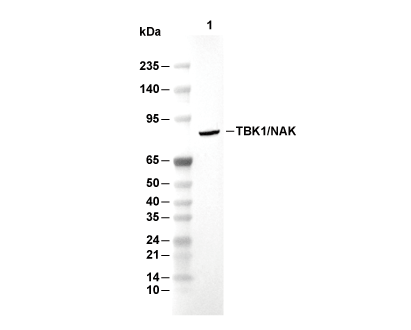 Lane 1: Raji