
|
受注:045-509-1970 |
技術サポート:tech@selleck.co.jp 平日9:00〜18:00 1営業日以内にご連絡を差し上げます |
化学情報
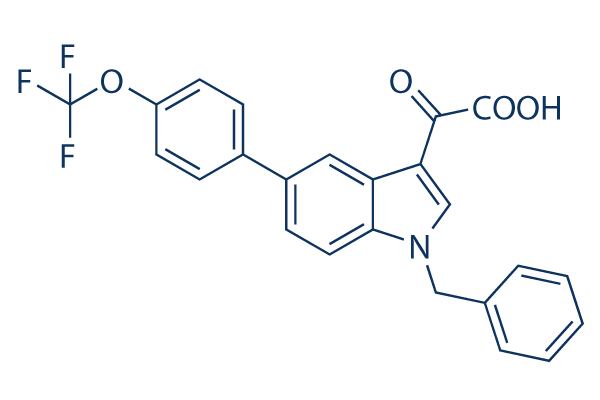
|
Synonyms | N/A | Storage (From the date of receipt) |
3 years -20°C powder 1 years -80°C in solvent |
| 化学式 | C24H16F3NO4 |
|||
| 分子量 | 439.38 | CAS No. | 393105-53-8 | |
| Solubility (25°C)* | 体外 | DMSO | 88 mg/mL (200.28 mM) | |
| Ethanol | 7 mg/mL warmed with 60ºC water bath (15.93 mM) | |||
| Water | Insoluble | |||
|
* <1 mg/ml means slightly soluble or insoluble. * Please note that Selleck tests the solubility of all compounds in-house, and the actual solubility may differ slightly from published values. This is normal and is due to slight batch-to-batch variations. |
||||
溶剤液(一定の濃度)を調合する
生物活性
| 製品説明 | Tiplaxtinin(PAI-039)は、経口で有効な選択的プラスミノーゲンアクチベーターインヒビター-1(PAI-1)阻害剤であり、IC50は2.7 µMです。 |
|---|---|
| in vitro | Tiplaxtinin (PAI-039) reduces cellular proliferation, cell adhesion, and colony formation, and induces apoptosis and anoikis in a panel of human bladder cell lines. |
| in vivo | Tiplaxtinin (PAI-039) has been shown in multiple studies to exhibit various biological effects. In a rat carotid thrombosis model, it (1 mg/kg, p.o.) increases time to occlusion and prevents the carotid blood flow reduction. In C57BL/6J mice, (1 mg/g chow) attenuates Ang II-induced aortic remodeling. In untreated type 1 diabetic mice, this compound (p.o.) restores skeletal muscle regeneration. In athymic mice bearing human cancer cell line T24 and HeLa xenografts, it (1 mg/kg, p.o.) reduces tumor xenograft growth, associated with a reduction in tumor angiogenesis, a reduction in cellular proliferation, and an increase in apoptosis. |
プロトコル(参考用のみ)
| キナーゼアッセイ | Direct PAI-I in vitro activity assays | |
|---|---|---|
| The chromogenic assay is initiated by the addition of Tiplaxtinin (PAI-039) (10 – 100 µM final concentration, maximum DMSO concentration of 0.2%) to recombinant human PAI-1 (140 nM in pH 6.6 buffer). After a 15 minute incubation at 25°C, 70 nM of recombinant human t-PA is added, and the combination of this compound, PAI-1 and tPA are incubated for an additional 30 minutes. After the second incubation, Spectrozyme tPA, is added and absorbance read at 405 nm at 0 and 60 minutes. Relative PAI-1 inhibitory activity is equal to the residual tPA activity in the tiplaxtinin / PAI-1 treatment. Control treatments include the complete inhibition of tPA by PAI-1 at the molar ratio employed (2:1), and the absence of any effect of it on t-PA alone. The immunofunctional assay is based upon the non-SDS dissociable interaction between tPA and active PAI-1. Assay plates are coated with 100 µl of a solution of t-PA (10 µg/ml in TBS), and kept at 4 °C overnight. This compound is dissolved in DMSO and diluted to a final concentration of 1-100 µM as described above. It is then incubated with human PAI-1 (50 ng/ml) for 15 minutes, and an aliquot of this solution added to the t-PA-coated plate for 1 h. The solution is aspirated from the plate, which is then washed with a buffer consisting of 0.05% Tween 20 and 0.1% BSA in TBS. This assay detects only active inhibitory PAI-1 (not latent or substrate) bound to the plate, and is quantitated using a monoclonal antibody against human PAI-1 (MA33B8). A 1000X dilution of MA33B8 is added to the plate and incubated at for one hour, aspirated and washed. A secondary antibody consisting of goat anti-mouse IgG (H+L)-AP alkaline phosphatase conjugate is added, incubated for one hour, aspirated and washed. A 100 µl aliquot of alkaline phosphatase solution is added, followed by determination of absorbance at 405 nm 60 minutes later. The quantitation of residual active PAI-1 bound to t-PA at varying concentrations of it is used to determine the IC50 by fitting the results to a logistic dose-response program, with the IC50 defined as the concentration of compound required to achieve 50% inhibition of PAI-1 activity. The assay sensitivity is 5 ng/ml of human PAI-1 as determined from a standard curve ranging from 0-100 ng/ml of human PAI-1. | ||
| 細胞アッセイ | 細胞株 | T24, UM-UC-14, UROtsa, and HeLa cells |
| 濃度 | ~50 μM | |
| 反応時間 | 24 h | |
| 実験の流れ | Briefly, cell lines, T24, UM-UC-14, UROtsa, and HeLa cells are plated in 96-well dishes in triplicate at 1 ?103 cells per well and allowed to adhere for 24 hours. Subsequently, tiplaxtinin (PAI-039) is added to the wells and allowed to incubate at the indicated concentrations. Cellular proliferation is determined by CellTiter-Glo Luminescent Cell Viability Assay according to manufacturer's instructions at 24 hours, and its IC50 is determined in Graphpad Prism. Luminescence was measured using a FLUOstar OPTIMA Reader. | |
| 動物実験 | 動物モデル | Rat with carotid thrombosis |
| 投薬量 | 1 mg/kg | |
| 投与方法 | p.o. | |
参考
|
カスタマーフィードバック

-
Data from [Data independently produced by , , Development, 2017, 144(8):1425-1440]
Selleckの高級品が、幾つかの出版された研究調査結果(以下を含む)で使われた:
| Fibrin defines tissue stiffness and biomechanical signaling in regenerating zebrafish hearts as revealed by high-resolution stiffness mapping [ iScience, 2026, 29(4):115231] | PubMed: 41940341 |
| Omentum-Derived Mesenchymal Stem Cells Promote Antibacterial Effects and Protect Endothelial Functions via PAI-1 [ Stem Cell Rev Rep, 2026, 22(5):2491-2510.] | PubMed: 42018237 |
| Modeling oxaliplatin resistance in colorectal cancer reveals a SERPINE1-based gene signature (RESIST-M) and therapeutic strategies for pro-metastatic CMS4 subtype [ Cell Death Dis, 2025, 16(1):529] | PubMed: 40664638 |
| Cellular senescence as a prognostic marker for predicting breast cancer progression in 2D and 3D organoid models [ Biomed Pharmacother, 2025, 189:118324] | PubMed: 40616881 |
| ProBDNF as a Myokine in Skeletal Muscle Injury: Role in Inflammation and Potential for Therapeutic Modulation of p75NTR [ Int J Mol Sci, 2025, 26(1)401] | PubMed: 39796256 |
| hapln1a+ cells guide coronary growth during heart morphogenesis and regeneration [ Nat Commun, 2023, 14(1):3505] | PubMed: 37311876 |
| CSE reduces OTUD4 triggering lung epithelial cell apoptosis via PAI-1 degradation [ Cell Death Dis, 2023, 14(9):614] | PubMed: 37726265 |
| CSE reduces OTUD4 triggering lung epithelial cell apoptosis via PAI-1 degradation [ Cell Death Dis, 2023, 10.1038/s41419-023-06131-1] | PubMed: 37726265 |
| Ligand-mediated PAI-1 inhibition in a mouse model of peritoneal carcinomatosis [ Cell Rep Med, 2022, 3(2):100526] | PubMed: 35243423 |
| ProBDNF Dependence of LTD and Fear Extinction Learning in the Amygdala of Adult Mice [ Cereb Cortex, 2022, 32(7):1350-1364] | PubMed: 34470044 |
長期の保管のために-20°Cの下で製品を保ってください。
人間や獣医の診断であるか治療的な使用のためにでない。
各々の製品のための特定の保管と取扱い情報は、製品データシートの上で示されます。大部分のSelleck製品は、推薦された状況の下で安定です。製品は、推薦された保管温度と異なる温度で、時々出荷されます。長期の保管のために必要とされてそれと異なる温度で、多くの製品は、短期もので安定です。品質を維持するが、夜通しの積荷のために最も経済的な貯蔵状況を用いてあなたの送料を保存する状況の下に、製品が出荷されることを、我々は確実とします。製品の受領と同時に、製品データシートの上で貯蔵推薦に従ってください。