
|
受注:045-509-1970 |
技術サポート:tech@selleck.co.jp 平日9:00〜18:00 1営業日以内にご連絡を差し上げます |
生物学的記述
| Specificity | TNFRSF8/CD30 Antibody [G5N10] detects endogenous levels of total TNFRSF8/CD30 protein. |
|---|---|
| Background | TNFRSF8, commonly known as CD30, belongs to the tumor necrosis factor receptor (TNFR) superfamily and functions as a type-I transmembrane glycoprotein that modulates immune cell activation and survival. It features an extracellular cysteine-rich domain for ligand binding and a cytoplasmic tail with distinct D1, D2, and D3 subdomains that recruit signaling adaptors. CD30 primarily signals through direct binding to TRAF2 and TRAF5 via its D2 domain, triggering two competing pathways: rapid TRAF2 degradation that sensitizes cells to apoptosis through caspase activation, and NF-κB canonical activation via IKK complex recruitment, leading to p65/RelA nuclear translocation and transcription of prosurvival genes like Bcl-xL and cytokine regulators. In anaplastic large cell lymphoma (ALCL) cells, CD30 stimulation induces TRAF2 downregulation and NF-κB impairment, promoting caspase-dependent cell death, whereas in Hodgkin lymphoma cells, constitutive low-level signaling maintains TRAF2 stability and sustains NF-κB activity to block apoptosis. This context-dependent duality arises from dosage effects and co-receptor interactions, with TACE-mediated ectodomain shedding further attenuating ligand-dependent responses by reducing surface CD30. CD30 fine-tunes T-cell expansion and B-cell maturation by balancing proliferation against programmed death, making it valuable for researchers dissecting TRAF-NF-κB crosstalk in lymphocyte fate decisions or immune checkpoint modulation. Its expression on activated lymphocytes supports normal germinal center reactions and memory formation, with regulatory control via JunB and NPM-ALK in pathologic states influencing therapeutic windows. Dysregulation through overexpression drives lymphomagenesis in Hodgkin and ALCL by sustaining oncogenic NF-κB, while fusion proteins amplify its prosurvival arm. |
使用情報
| Application | WB, IHC, IF, FCM | Dilution |
|
||||||||
|---|---|---|---|---|---|---|---|---|---|---|---|
| Reactivity | Human, Monkey | ||||||||||
| Source | Rabbit Monoclonal Antibody | MW | 90 kDa, 120 kDa | ||||||||
| Storage Buffer | PBS, pH 7.2+50% Glycerol+0.05% BSA+0.01% NaN3 | Storage (from the date of receipt) |
-20°C (avoid freeze-thaw cycles), 2 years | ||||||||
References
|
Application Data
WB
Validated by Selleck
-
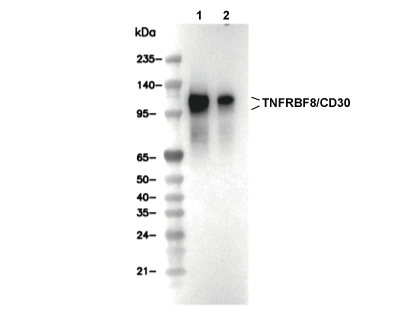 Lane 1: HDLM-2, Lane 2: Karpas-299