
|
受注:045-509-1970 |
技術サポート:tech@selleck.co.jp 平日9:00〜18:00 1営業日以内にご連絡を差し上げます |
生物学的記述
| Specificity | Toll-like Receptor 9 Antibody [M15F23] detects endogenous levels of total Toll-like Receptor 9 protein. |
|---|---|
| Background | Toll-like receptor 9 belongs to the Toll-like receptor family of pattern recognition receptors and functions primarily as an intracellular sensor for microbial DNA. It possesses an extracellular leucine-rich repeat domain for ligand recognition and a cytoplasmic Toll/interleukin-1 receptor domain that recruits adaptor proteins. TLR9 localizes to the endoplasmic reticulum and undergoes proteolytic cleavage in endolysosomal compartments to generate a mature form capable of ligand binding at acidic pH in resting cells. Unmethylated CpG-containing DNA binds directly to the cleaved TLR9 ectodomain, inducing dimerization and recruitment of MyD88 along with TIRAP to form a signaling complex that activates IRAK4 and IRAK1 kinases. Phosphorylated IRAKs associate with TRAF6, which undergoes K63-linked auto-ubiquitination to activate TAK1, leading to IKK complex phosphorylation and subsequent IκBα degradation, thereby enabling NF-κB nuclear translocation and transcription of proinflammatory cytokines including TNF-α, IL-6, IL-12, and type I interferons. TLR9 signaling also engages the MAPK cascade through p38, JNK, and ERK phosphorylation, amplifying AP-1 activity to coordinate innate immune responses in plasmacytoid dendritic cells, macrophages, and B cells. MyD88-independent TRIF-mediated activation contributes to IRF7 phosphorylation and interferon-β production upon prolonged stimulation. Trafficking from ER through Golgi to lysosomes requires UNC93B1 chaperone activity, with endosomal acidification essential for ligand access and signal initiation. Expression predominates in immune cells, with isoforms arising from alternative splicing influencing ligand specificity. Dysregulation through polymorphisms or overexpression links TLR9 to autoimmune diseases such as systemic lupus erythematosus and rheumatoid arthritis, where self-DNA recognition drives chronic inflammation. |
使用情報
| Application | WB, IP, IF, FCM | Dilution |
|
||||||||
|---|---|---|---|---|---|---|---|---|---|---|---|
| Reactivity | Human | ||||||||||
| Source | Rabbit Monoclonal Antibody | MW | 130 kDa | ||||||||
| Storage Buffer | PBS, pH 7.2+50% Glycerol+0.05% BSA+0.01% NaN3 | Storage (from the date of receipt) |
-20°C (avoid freeze-thaw cycles), 2 years | ||||||||
References
|
Application Data
WB
Validated by Selleck
-
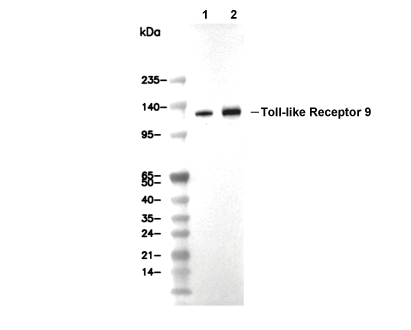 Lane 1: Ramos, Lane 2: Raji