
|
受注:045-509-1970 |
技術サポート:tech@selleck.co.jp 平日9:00〜18:00 1営業日以内にご連絡を差し上げます |
生物学的記述
| Specificity | ZEB2 Antibody [J21B10] detects endogenous levels of total ZEB2 protein. |
|---|---|
| Background | ZEB2 belongs to the zinc finger E-box binding homeobox family of transcription factors and operates as a DNA-binding repressor with critical roles in development and cellular plasticity. It contains N-terminal and C-terminal zinc finger domains flanking a central homeodomain, enabling sequence-specific binding to E-box motifs (CAGGTG) and recruitment of corepressor complexes like CtBP and NuRD. ZEB2 interacts directly with phosphorylated R-SMAD2/3 downstream of TGF-β/BMP signaling, forming a complex that represses epithelial genes such as E-cadherin (CDH1), Crumbs3, and claudins while activating mesenchymal genes including N-cadherin, vimentin, fibronectin, and MMPs, to drive epithelial-mesenchymal transition. This repression occurs through chromatin remodeling via HDAC1/2 recruitment and histone deacetylation at target promoters, with ZEB2 also undergoing auto-regulatory feedback by binding its own promoter. ZEB2 coordinates neuroectoderm induction from BMP/Wnt signals, promotes neural crest delamination and migration by repressing Foxd3 and Sox10, and directs hippocampal and neocortical layering through radial glia specification. TGF-β-induced ZEB2 expression sustains EMT in migrating neural crest cells and trophoblast invasion, while in T cell differentiation, it enforces Th17 commitment via RORγt stabilization and IL-17 production. Post-translational SUMOylation at lysine residues enhances ZEB2 stability and activity, whereas miR-200 family members form a double-negative feedback loop to balance epithelial state. During injury repair, ZEB2 drives astrocyte proliferation and Schwann cell differentiation for remyelination via EMT programs. Haploinsufficiency causes Mowat-Wilson syndrome with neurodevelopmental defects, including Hirschsprung disease and intellectual disability, while overexpression correlates with poor prognosis in ovarian, colorectal, and melanoma through metastasis and stemness maintenance. |
使用情報
| Application | WB, IHC, IF, ELISA | Dilution |
|
||||||
|---|---|---|---|---|---|---|---|---|---|
| Reactivity | Human | ||||||||
| Source | Rabbit Monoclonal Antibody | MW | 136 kDa | ||||||
| Storage Buffer | PBS, pH 7.2+50% Glycerol+0.05% BSA+0.01% NaN3 | Storage (from the date of receipt) |
-20°C (avoid freeze-thaw cycles), 2 years | ||||||
References
|
Application Data
WB
Validated by Selleck
-
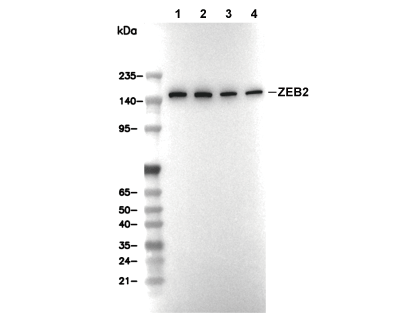 Lane 1: HepG2, Lane 2: Hela, Lane 3: A549, Lane 4: K562