| NeuroD1 (NEUROD1, also called β2) is a NeuroD‑family basic helix‑loop‑helix transcription factor that heterodimerizes with E‑proteins to bind E‑box motifs (5′‑CANNTG‑3′) and acts as a potent transcriptional activator controlling terminal differentiation and functional maturation in both neuronal and endocrine lineages. The protein contains an N‑terminal transactivation region, a central bHLH DNA‑binding and dimerization domain, and a C‑terminal region that recruits coactivators such as p300/CBP and interfaces with signaling‑dependent post‑translational modifications, enabling NeuroD1 to associate with enhancer elements of key neurogenic and endocrine genes and to remodel local chromatin states. In the nervous system, NeuroD1 expression marks the transition from progenitor to committed neuron, where it drives transcriptional programs for neuronal differentiation, dendrite morphogenesis, and survival by activating genes required for retinal ganglion cell formation, inner ear sensory neuron specification, hippocampal and cerebellar granule cell development, and cortical excitatory neuron maturation; it binds enhancers near transcriptional regulators of neurogenesis and cooperates with other fate determinants in sequential cascades that convert Pax6/Neurog2‑positive progenitors into Tbr2/Tbr1‑lineage neurons. NeuroD1 is phosphorylated in a signal‑dependent manner at multiple serine residues: ERK‑ and glucose‑regulated phosphorylation within its C‑terminal region, including at sites corresponding to Ser274 and Ser266 in islet cells, enhances its transactivation on the insulin promoter and supports nuclear accumulation, while neuronal activity and ERK pathway input adjust its stability, ubiquitination, and capacity to promote neurite outgrowth and dendritic complexity, integrating extracellular cues into transcriptional control over neuronal architecture. In the endocrine pancreas, NeuroD1 is expressed in differentiating endocrine progenitors and later maintained in β‑cells and a subset of α‑cells, where it regulates insulin gene expression and a network of β‑cell transcription factors including Pdx1, Nkx2.2, MafA, MafB, Pax4, and Pax6, thereby coordinating endocrine cell fate specification, β‑cell functional maturation, and stimulus–secretion coupling; transcriptomic and epigenomic profiling shows that NeuroD1 reshapes both chromatin and gene expression landscapes to enforce endocrine identity and sustain glucose‑responsive insulin production. Genetic disruption of NEUROD1 in humans causes monogenic diabetes phenotypes such as maturity‑onset diabetes of the young type 6 and permanent neonatal diabetes, consistent with its essential role in β‑cell development and function, and NEUROD1 variants contribute to multifactorial type 2 diabetes susceptibility by altering insulin promoter regulation and β‑cell gene networks. Beyond classical developmental roles, forced expression of NeuroD1 in reactive glia drives astrocyte‑to‑neuron conversion with broad transcriptomic reprogramming, and NeuroD1‑dependent transcriptional modules also participate in pituitary gonadotrope cell motility via a Neurod1/4–Ntrk3–Src axis. |


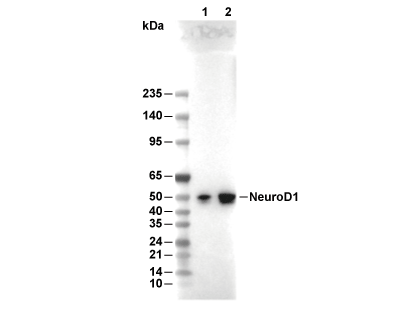 Lane 1: IMR-32, Lane 2: INS-1