
- 阻害剤
- 研究分野別
- PI3K/Akt/mTOR
- Epigenetics
- Methylation
- Immunology & Inflammation
- Protein Tyrosine Kinase
- Angiogenesis
- Apoptosis
- Autophagy
- ER stress & UPR
- JAK/STAT
- MAPK
- Cytoskeletal Signaling
- Cell Cycle
- TGF-beta/Smad
- 化合物ライブラリー
- 抗体
- 新製品
- お問い合わせ

SLC22A2/OCT2 Antibody [D23A15]
Catalog No.: F4543
Application:
Reactivity:
-
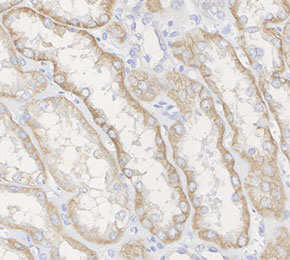 Immunohistochemical analysis of formalin fixed paraffin embedded human stomach tissue with F4543 at 1:20 dilution.
当該製品は品切れ状态で、メールアドレスをご教示いただければ、お客様に返信いたします。
代表番号: 045-509-1970|電子メール:sales@selleck.co.jp
使用情報
| Dilution |
|---|
|
| Application |
|---|
| IHC, FCM |
| Source |
|---|
| Mouse Monoclonal Antibody |
| Reactivity |
|---|
| Human |
| Storage Buffer |
|---|
| PBS, pH 7.2+50% Glycerol+0.05% BSA+0.01% NaN3 |
| Storage (from the date of receipt) |
|---|
| -20°C (avoid freeze-thaw cycles), 2 years |
| ポジティブコントロール | Human kidney |
|---|---|
| ネガティブコントロール |
プロトコール
| IHC |
|---|
Experimental Protocol:
Deparaffinization/Rehydration
1. Deparaffinize/hydrate sections:
2. Incubate sections in three washes of xylene for 5 min each.
3. Incubate sections in two washes of 100% ethanol for 10 min each.
4. Incubate sections in two washes of 95% ethanol for 10 min each.
5. Wash sections two times in dH2O for 5 min each.
6.Antigen retrieval: For Citrate: Heat slides in a microwave submersed in 1X citrate unmasking solution until boiling is initiated; continue with 10 min at a sub-boiling temperature (95°-98°C). Cool slides on bench top for 30 min.
Staining
1. Wash sections in dH2O three times for 5 min each.
2. Incubate sections in 3% hydrogen peroxide for 10 min.
3. Wash sections in dH2O two times for 5 min each.
4. Wash sections in wash buffer for 5 min.
5. Block each section with 100–400 µl of blocking solution for 1 hr at room temperature.
6. Remove blocking solution and add 100–400 µl primary antibody diluent in to each section. Incubate overnight at 4°C.
7. Remove antibody solution and wash sections with wash buffer three times for 5 min each.
8. Cover section with 1–3 drops HRPas needed. Incubate in a humidified chamber for 30 min at room temperature.
9. Wash sections three times with wash buffer for 5 min each.
10. Add DAB Chromogen Concentrate to DAB Diluent and mix well before use.
11. Apply 100–400 µl DAB to each section and monitor closely. 1–10 min generally provides an acceptable staining intensity.
12. Immerse slides in dH2O.
13. If desired, counterstain sections with hematoxylin.
14. Wash sections in dH2O two times for 5 min each.
15. Dehydrate sections: Incubate sections in 95% ethanol two times for 10 sec each; Repeat in 100% ethanol, incubating sections two times for 10 sec each; Repeat in xylene, incubating sections two times for 10 sec each.
16. Mount sections with coverslips and mounting medium.
|
生物学的記述
| Specificity |
|---|
| SLC22A2/OCT2 Antibody [D23A15] detects endogenous levels of total SLC22A2/OCT2 protein. |
| タンパク質の局在 |
|---|
| 細胞膜、細胞内膜系 |
| Uniprot ID |
|---|
| O15244 |
| Clone |
|---|
| D23A15 |
| Synonym(s) |
|---|
| hOCT2; MGC32628; OCT2; OCT2Organic cation transporter 2; SLC22A2; solute carrier family 22 (organic cation transporter), member 2; solute carrier family 22 member 2 |
| Background |
|---|
| SLC22A2, also known as Organic Cation Transporter 2 (OCT2), is a polyspecific facilitative transporter (~63 kDa) in the SLC22 family. Predominantly expressed on the basolateral membrane of renal proximal tubule cells, OCT2 features 12 transmembrane-spanning domains that form an inward-facing substrate binding cavity. It possesses a large extracellular loop 2 containing glycosylation sites for conformational stability, and key residues such as Asp449 and Trp222 are critical for cation recognition and managing protonation states during transport. OCT2 operates through an alternating access mechanism, utilizing the electrochemical gradient (typically -50 to -70 mV) without requiring ATP or Na⁺ coupling. This transporter moves organic cations, including metformin, cisplatin, histamine, dopamine, and creatinine, bidirectionally, with a predominant role in basolateral uptake into tubular cells for vectorial secretion. OCT2 shows a slight preference for smaller monovalent cations (Km 10–500 μM) and relies on transient pore openings triggered by substrate occlusion, which flips substrate accessibility. Electrostatic interactions with positively charged amines enable cation selectivity, while anions are excluded. This activity is crucial for clearing systemic toxins, neurotransmitters, and for the disposition of xenobiotics in the liver, neurons, and placenta. Common OCT2 variants (e.g., R270S, A270S) reduce transport capacity by 20–50% for certain substrates, increasing the risk of nephrotoxicity with platinum chemotherapeutics and reducing metformin efficacy in diabetes. |
| References |
|---|
技術サポート
ストックの作り方、阻害剤の保管方法、細胞実験や動物実験の際に注意すべき点など、製品を取扱う時に問い合わせが多かった質問に対しては取扱説明書でお答えしています。
他に質問がある場合は、お気軽にお問い合わせください。
* 必須


納期 国内在庫品:受注日の翌日(15時までの受注分) *北海道、九州、沖縄への配送は受注日より2日以上 を要する場合あり 海外在庫品:受注後1〜2週間