
- 阻害剤
- 研究分野別
- PI3K/Akt/mTOR
- Epigenetics
- Methylation
- Immunology & Inflammation
- Protein Tyrosine Kinase
- Angiogenesis
- Apoptosis
- Autophagy
- ER stress & UPR
- JAK/STAT
- MAPK
- Cytoskeletal Signaling
- Cell Cycle
- TGF-beta/Smad
- 化合物ライブラリー
- 抗体
- 新製品
- お問い合わせ

COL4A2 Antibody (Rabbit mAb) [K16J16]
Catalog No.: F8837
Application:
Reactivity:
-
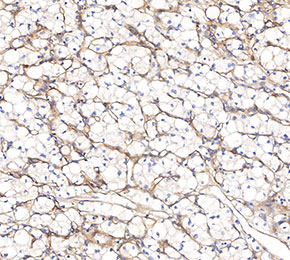 Immunohistochemical analysis of formalin fixed paraffin embedded human kidney tissue with F8837 at 1:500 dilution.
当該製品は品切れ状态で、メールアドレスをご教示いただければ、お客様に返信いたします。
代表番号: 045-509-1970|電子メール:sales@selleck.co.jp
使用情報
| Dilution |
|---|
|
| Application |
|---|
| IHC |
| Source |
|---|
| Rabbit Monoclonal Antibody |
| Reactivity |
|---|
| Human, Mouse, Rat |
| Storage Buffer |
|---|
| PBS, pH 7.2+50% Glycerol+0.05% BSA+0.01% NaN3 |
| Storage (from the date of receipt) |
|---|
| -20°C (avoid freeze-thaw cycles), 2 years |
| Predicted MW |
|---|
| 168 kDa |
| ポジティブコントロール | Mouse cerebrum tissue; Mouse lung tissue; Human kidney tissue; Human cerebrum tissue; Rat cerebrum tissue; Rat lung tissue; Human esophagus endothelium and smooth muscle tissue; Rat liver endothelium tissue; Mouse liver endothelium tissue |
|---|---|
| ネガティブコントロール |
プロトコール
| IHC |
|---|
Experimental Protocol:
Deparaffinization/Rehydration
1. Deparaffinize/hydrate sections:
2. Incubate sections in three washes of xylene for 5 min each.
3. Incubate sections in two washes of 100% ethanol for 10 min each.
4. Incubate sections in two washes of 95% ethanol for 10 min each.
5. Wash sections two times in dH2O for 5 min each.
6.Antigen retrieval: For Citrate: Heat slides in a microwave submersed in 1X citrate unmasking solution until boiling is initiated; continue with 10 min at a sub-boiling temperature (95°-98°C). Cool slides on bench top for 30 min.
Staining
1. Wash sections in dH2O three times for 5 min each.
2. Incubate sections in 3% hydrogen peroxide for 10 min.
3. Wash sections in dH2O two times for 5 min each.
4. Wash sections in wash buffer for 5 min.
5. Block each section with 100–400 µl of blocking solution for 1 hr at room temperature.
6. Remove blocking solution and add 100–400 µl primary antibody diluent in to each section. Incubate overnight at 4°C.
7. Remove antibody solution and wash sections with wash buffer three times for 5 min each.
8. Cover section with 1–3 drops HRPas needed. Incubate in a humidified chamber for 30 min at room temperature.
9. Wash sections three times with wash buffer for 5 min each.
10. Add DAB Chromogen Concentrate to DAB Diluent and mix well before use.
11. Apply 100–400 µl DAB to each section and monitor closely. 1–10 min generally provides an acceptable staining intensity.
12. Immerse slides in dH2O.
13. If desired, counterstain sections with hematoxylin.
14. Wash sections in dH2O two times for 5 min each.
15. Dehydrate sections: Incubate sections in 95% ethanol two times for 10 sec each; Repeat in 100% ethanol, incubating sections two times for 10 sec each; Repeat in xylene, incubating sections two times for 10 sec each.
16. Mount sections with coverslips and mounting medium.
|
生物学的記述
| Specificity |
|---|
| COL4A2 Antibody (Rabbit mAb) [K16J16] detects endogenous levels of total COL4A2 protein. |
| Uniprot ID |
|---|
| P08572 |
| Clone |
|---|
| K16J16 |
| Synonym(s) |
|---|
| Collagen alpha-2(IV) chain, COL4A2 |
| Background |
|---|
| COL4A2 encodes the collagen type IV alpha 2 chain, which pairs with COL4A1 to form the prototypic α1(IV)₂α2(IV) heterotrimer that constitutes a major structural scaffold of basement membranes in vascular, renal, neural, and many other tissues, where this network combines with laminins, nidogen, and heparan sulfate proteoglycans to generate the characteristic “chicken‑wire” basement membrane meshwork that controls tissue architecture, barrier function, and cell–matrix signaling. The protein contains a large triple‑helical collagenous domain with Gly‑X‑Y repeats that self‑associate into higher‑order protomers and networks, flanked by a non‑collagenous NC1 domain at the C‑terminus; proteolytic processing of this NC1 domain yields the fragment canstatin, which exerts anti‑angiogenic and anti‑tumor activity by binding αvβ3 and αvβ5 integrins on endothelial and tumor cells, inhibiting proliferation and migration, reducing mitochondrial membrane potential, and inducing apoptosis through Fas‑dependent caspase‑8 and caspase‑9 activation and engagement of intrinsic death pathways. COL4A2 within the vessel wall basement membrane restrains vascular smooth muscle cell proliferation and provides mechanical stability and signaling cues to endothelial and mural cells, and its expression is regulated by transforming growth factor‑β via canonical Smad3/Smad4 signaling, where TGFβ1 stimulation increases COL4A1/COL4A2 mRNA and protein levels in human vascular smooth muscle cells, and pharmacologic ALK5 inhibition or combined SMAD3/SMAD4 knockdown abolishes this induction, demonstrating that TGFβ–Smad3/4 complexes act as necessary regulators of type IV collagen production in the arterial wall. Genetic and epistasis analyses link the COL4A1/COL4A2 locus with coronary artery disease risk, with interaction between COL4A1/COL4A2 variants and SMAD3 risk alleles supporting a functional axis in which TGFβ–Smad3‑dependent upregulation of COL4A2 influences extracellular matrix composition, vascular remodeling, and atherosclerotic susceptibility. Mutations in COL4A2, often shared mechanistically with COL4A1, impair proper folding, secretion, and network assembly of the α1(IV)₂α2(IV) heterotrimer, producing widespread basement membrane defects associated with cerebrovascular phenotypes including intracerebral hemorrhage, porencephaly, leukoencephalopathy, small‑vessel disease, and ocular and renal manifestations, reflecting the ubiquitous requirement of COL4A2‑containing collagen IV networks for microvascular integrity and organ homeostasis. In the liver, COL4A2 expression increases in preneoplastic and hepatocellular carcinoma tissues relative to normal liver and correlates with shorter progression‑free survival, and bioinformatic and network analyses indicate that COL4A1/2 engage integrin α2β1 to activate a signaling cascade centered on the PI3K–Akt pathway with connections to Wnt and MAPK pathways and downstream control of cell cycle and cytoskeletal organization, supporting a role for COL4A2‑rich extracellular matrix as a pro‑tumorigenic niche in hepatocarcinogenesis. Within tissue‑specific extracellular matrices such as the periodontal ligament niche, COL4A2 contributes to the osteogenic differentiation capacity of resident stem cells, indicating that COL4A2‑containing basement membrane and pericellular matrices provide instructive cues that direct lineage commitment and bone regeneration in a context‑dependent manner. |
| References |
|---|
技術サポート
ストックの作り方、阻害剤の保管方法、細胞実験や動物実験の際に注意すべき点など、製品を取扱う時に問い合わせが多かった質問に対しては取扱説明書でお答えしています。
他に質問がある場合は、お気軽にお問い合わせください。
* 必須

納期 国内在庫品:受注日の翌日(15時までの受注分) *北海道、九州、沖縄への配送は受注日より2日以上 を要する場合あり 海外在庫品:受注後1〜2週間