
- 阻害剤
- 研究分野別
- PI3K/Akt/mTOR
- Epigenetics
- Methylation
- Immunology & Inflammation
- Protein Tyrosine Kinase
- Angiogenesis
- Apoptosis
- Autophagy
- ER stress & UPR
- JAK/STAT
- MAPK
- Cytoskeletal Signaling
- Cell Cycle
- TGF-beta/Smad
- 化合物ライブラリー
- 抗体
- 新製品
- お問い合わせ

CRBN Antibody (Rabbit mAb) [M9N10]
Catalog No.: F7388
Application:
Reactivity:
-
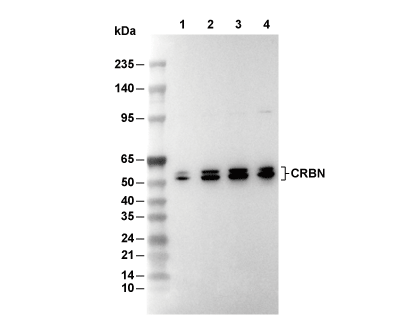 Lane 1: MOLT-4, Lane 2: Hela, Lane 3: NIH/3T3, Lane 4: C6
当該製品は品切れ状态で、メールアドレスをご教示いただければ、お客様に返信いたします。
代表番号: 045-509-1970|電子メール:sales@selleck.co.jp
使用情報
| Dilution |
|---|
|
| Application |
|---|
| WB, IP, FCM |
| Source |
|---|
| Rabbit Monoclonal Antibody |
| Reactivity |
|---|
| Human, Mouse |
| Storage Buffer |
|---|
| PBS, pH 7.2+50% Glycerol+0.05% BSA+0.01% NaN3 |
| Storage (from the date of receipt) |
|---|
| -20°C (avoid freeze-thaw cycles), 2 years |
| Predicted MW Observed MW |
|---|
| 50 kDa 50 kDa,36 kDa |
| *なぜ予測分子量と実際の分子量が異なるのか? 下記の原因により、実際の分子量が予測と異なる:タンパク質の翻訳後修飾(リン酸化/糖鎖付加),スプライシングバリアント,イソフォーム,相対的な電荷,ポリマー。 |
| ポジティブコントロール | Human hippocampus tissue; Human testis tissue; Human skeletal muscle tissue; Mouse brain tissue; Mouse testis tissue; Rat brain tissue; Rat testis tissue; Rat skeletal muscle tissue; HeLa cells; MOLT-4 cells; U266B1 cells; PC-3 cells; HEK-293 cells; NIH/3T3 cells; RAW 264.7 cells; C6 cells; PC-12 cells |
|---|---|
| ネガティブコントロール |
プロトコール
| WB |
|---|
Experimental Protocol:
Sample preparation
1. Tissue: Lyse the tissue sample by adding an appropriate volume of ice-cold RIPA/NP-40 Lysis Buffer (containing Protease Inhibitor Cocktail),and homogenize the tissue at a low temperature or lyse it by sonication on ice, then incubate on ice for 30 minutes. 2. Adherent cell: Aspirate the culture medium and wash the cells with ice-cold PBS twice. Lyse the cells by adding an appropriate volume of RIPA/NP-40 Lysis Buffer (containing Protease Inhibitor Cocktail) , sonicate to lyse the cells, and incubate on ice for 30 minutes. 3. Suspension cell: Transfer the culture medium to a pre-cooled centrifuge tube. Centrifuge and aspirate the supernatant. Wash the cells with ice-cold PBS twice. Lyse the cells by adding an appropriate volume of RIPA/NP-40 Lysis Buffer (containing Protease Inhibitor Cocktail) , sonicate to lyse the cells, and incubate on ice for 30 minutes. 4. Place the lysate into a pre-cooled microcentrifuge tube. Centrifuge at 4°C for 15 min. Collect the supernatant;
5. Remove a small volume of lysate to determine the protein concentration;
6. Combine the lysate with protein loading buffer. Boil 20 µL sample under 95-100°C for 5 min. Centrifuge for 5 min after cool down on ice.
Electrophoretic separation
1. According to the concentration of extracted protein, load appropriate amount of protein sample and marker onto SDS-PAGE gels for electrophoresis. Recommended separating gel (lower gel) concentration: 10%. Reference Table for Selecting SDS-PAGE Separation Gel Concentrations 2. Power up 80V for 30 minutes. Then the power supply is adjusted (110 V~150 V), the Marker is observed, and the electrophoresis can be stopped when the indicator band of the predyed protein Marker where the protein is located is properly separated. (Note that the current should not be too large when electrophoresis, too large current (more than 150 mA) will cause the temperature to rise, affecting the result of running glue. If high currents cannot be avoided, an ice bath can be used to cool the bath.)
Transfer membrane
1. Take out the converter, soak the clip and consumables in the pre-cooled converter;
2. Activate PVDF membrane with methanol for 1 min and rinse with transfer buffer;
3. Install it in the order of "black edge of clip - sponge - filter paper - filter paper - glue -PVDF membrane - filter paper - filter paper - sponge - white edge of clip"; 4. The protein was electrotransferred to PVDF membrane. ( 0.45 µm PVDF membrane is recommended ) Reference Table for Selecting PVDF Membrane Pore Size Specifications Recommended conditions for wet transfer: 200 mA, 120 min. ( Note that the transfer conditions can be adjusted according to the protein size. For high-molecular-weight proteins, a higher current and longer transfer time are recommended. However, ensure that the transfer tank remains at a low temperature to prevent gel melting.)
Block
1. After electrotransfer, wash the film with TBST at room temperature for 5 minutes;
2. Incubate the film in the blocking solution for 1 hour at room temperature;
3. Wash the film with TBST for 3 times, 5 minutes each time.
Antibody incubation
1. Use 5% skim milk powder to prepare the primary antibody working liquid (recommended dilution ratio for primary antibody 1:1000), gently shake and incubate with the film at 4°C overnight; 2. Wash the film with TBST 3 times, 5 minutes each time;
3. Add the secondary antibody to the blocking solution and incubate with the film gently at room temperature for 1 hour;
4. After incubation, wash the film with TBST 3 times for 5 minutes each time.
Antibody staining
1. Add the prepared ECL luminescent substrate (or select other color developing substrate according to the second antibody) and mix evenly;
2. Incubate with the film for 1 minute, remove excess substrate (keep the film moist), wrap with plastic film, and expose in the imaging system. |
生物学的記述
| Specificity |
|---|
| CRBN Antibody (Rabbit mAb) [M9N10] detects endogenous levels of total CRBN protein. |
| タンパク質の局在 |
|---|
| 細胞質、細胞内膜系、細胞核 |
| Uniprot ID |
|---|
| Q96SW2 |
| Clone |
|---|
| M9N10 |
| Synonym(s) |
|---|
| AD-006, CRBN, Protein cereblon |
| Background |
|---|
| Cereblon (CRBN) functions as the substrate receptor within the Cullin-RING E3 ubiquitin ligase 4 (CRL4^CRBN^) complex, which comprises DDB1, CUL4, RBX1, and CRBN, and mediates ubiquitination and proteasomal degradation of target proteins to regulate protein homeostasis, limb development, neuronal function, and immune signaling. CRBN adopts a tripartite architecture consisting of an N-terminal Lon protease-like domain, a central helical bundle domain mediating DDB1 interaction, and a C-terminal domain containing a pseudouridine synthase and archaeosine transglycosylase (PUA) fold that harbors both the substrate recognition interface and a conserved zinc-binding site coordinated by cysteine residues. The protein serves as a DCAF (DDB1-CUL4 associated factor) substrate receptor, positioning bound substrates within the ubiquitination zone generated by rotational mobility of the CUL4 ligase arm around DDB1, establishing spatial dimensions permitting promiscuous lysine targeting on proteins that enter this catalytic volume. CRBN recognizes endogenous substrates including the homeobox transcription factor MEIS2 through its C-terminal PUA domain, mediating their ubiquitination and degradation to control developmental gene expression programs and cellular differentiation. Thalidomide and its derivatives lenalidomide and pomalidomide bind a hydrophobic pocket within the CRBN C-terminal domain with dissociation constants ranging from approximately 150 to 250 nanomolar, occupying the canonical substrate recognition interface through glutarimide moiety interactions with His380 and Trp382 and establishing extensive van der Waals contacts with Trp382, Trp388, Trp402, and Phe404. Immunomodulatory drug (IMiD) binding to CRBN produces dual opposing effects—blocking recruitment and degradation of endogenous substrates like MEIS2 while simultaneously creating novel recognition interfaces that recruit neosubstrates including the Ikaros family transcription factors IKZF1 and IKZF3 for ubiquitination and degradation, functioning as molecular glue degraders that reprogram CRL4^CRBN^ substrate specificity. The solvent-exposed phthalimide C4 aniline functionality present in lenalidomide and pomalidomide but absent in thalidomide contributes directly to neosubstrate recruitment, with modifications at this position modulating degradation efficiency through altered protein-protein interaction surfaces formed between CRBN, bound IMiD, and target proteins containing glycine-loop (G-loop) recognition motifs. CRBN autoubiquitination occurs at unstructured N-terminal lysine residues K39 and K43, with this modification subject to inhibition by the COP9 signalosome (CSN), and IMiD binding does not prevent CRBN autoubiquitination, maintaining ligase activity while redirecting substrate specificity. The protein regulates large-conductance calcium-activated potassium (BK) channels by controlling their ubiquitination status, thereby modulating channel assembly, neuronal surface expression, and presynaptic glutamate release, which governs cognitive functions including memory and learning. CRBN participates in Toll-like receptor 4 (TLR4) signaling through interaction with TRAF6 and ECSIT, inhibiting ECSIT ubiquitination and suppressing inflammatory pathway activation. Loss-of-function mutations in CRBN, including the nonsense mutation R419X causing premature truncation after residue 419, associate with autosomal recessive nonsyndromic intellectual disability, likely through disrupted regulation of BK channel-mediated neuronal excitability and altered substrate recognition due to loss of C-terminal structural elements bordering the substrate-binding pocket. CRBN expression determines sensitivity to IMiD-based therapies in multiple myeloma, with CRBN loss representing a common resistance mechanism that abrogates lenalidomide and pomalidomide efficacy by eliminating the substrate receptor required for IKZF1 and IKZF3 degradation. The protein exhibits ubiquitous tissue expression with particularly high levels in testis, brain, kidney, and muscle, and exhibits cytoplasmic localization where it assembles with CRL4 complex components to execute spatially regulated ubiquitination events. |
| References |
|---|
技術サポート
ストックの作り方、阻害剤の保管方法、細胞実験や動物実験の際に注意すべき点など、製品を取扱う時に問い合わせが多かった質問に対しては取扱説明書でお答えしています。
他に質問がある場合は、お気軽にお問い合わせください。
* 必須

納期 国内在庫品:受注日の翌日(15時までの受注分) *北海道、九州、沖縄への配送は受注日より2日以上 を要する場合あり 海外在庫品:受注後1〜2週間