
- 阻害剤
- 研究分野別
- PI3K/Akt/mTOR
- Epigenetics
- Methylation
- Immunology & Inflammation
- Protein Tyrosine Kinase
- Angiogenesis
- Apoptosis
- Autophagy
- ER stress & UPR
- JAK/STAT
- MAPK
- Cytoskeletal Signaling
- Cell Cycle
- TGF-beta/Smad
- 化合物ライブラリー
- 抗体
- 新製品
- お問い合わせ

CX3CL1/Fractalkine Chemokine Domain Antibody (Rat mAb) [K3M15]
Catalog No.: F3830
Application:
Reactivity:
-
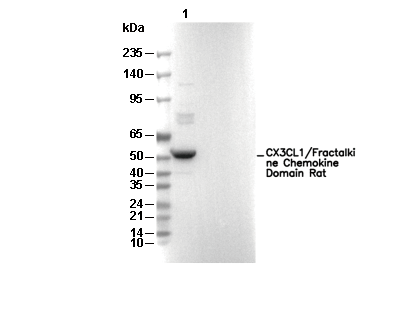 Lane 1: Mouse brain
キーポイント
この抗体には抗ラット二次抗体が必要です。
使用情報
| Dilution |
|---|
|
| Application |
|---|
| WB, ELISA |
| Source |
|---|
| Rat Monoclonal Antibody |
| Reactivity |
|---|
| Mouse |
| Storage Buffer |
|---|
| PBS, pH 7.2+50% Glycerol+0.05% BSA+0.01% NaN3 |
| Storage (from the date of receipt) |
|---|
| -20°C (avoid freeze-thaw cycles), 2 years |
| Predicted MW |
|---|
| 42 kDa |
生物学的記述
| Specificity |
|---|
CX3CL1/Fractalkine Chemokine Domain Antibody (Rat mAb) [K3M15] detects endogenous levels of total CX3CL1/Fractalkine Chemokine Domain protein. |
| タンパク質の局在 |
|---|
| 細胞膜、細胞内膜系、細胞外環境 |
| Uniprot ID |
|---|
| P78423 |
| Clone |
|---|
| K3M15 |
| Synonym(s) |
|---|
| ABCD-3; C3Xkine; chemokine (C-X3-C motif) ligand 1; CX3C membrane-anchored chemokine; CX3CL1; CXC3; CXC3C; FKN; Fractalkine; Neurotactin; neurotactin); NTNsmall inducible cytokine subfamily D (Cys-X3-Cys), member 1 (fractalkine; NTTSmall-inducible cytokine D1; SCYD1C-X3-C motif chemokine 1; small inducible cytokine subfamily D (Cys-X3-Cys), member- |
| Background |
|---|
| CX3CL1, also known as fractalkine, is the only member of the CX3C chemokine family and is distinguished by three amino acids separating its first two conserved cysteine residues. It is synthesized as a 373-amino acid type I transmembrane protein consisting of four major domains: an N-terminal chemokine domain that mediates chemoattraction, a mucin-like stalk that supports cell adhesion, a transmembrane segment that anchors the protein to the cell surface, and a cytoplasmic domain involved in intracellular signaling. Fractalkine uniquely exhibits both chemotactic and adhesive properties, acting as a membrane-bound adhesion molecule and, upon cleavage by metalloproteinases ADAM10 and ADAM17, functioning as a soluble chemoattractant. Its receptor, CX3CR1, is a G protein-coupled receptor expressed on immune and vascular cells, including monocytes, macrophages, NK cells, T cells, and smooth muscle cells. The binding of CX3CL1 to CX3CR1 activates multiple signaling pathways, including PI3K, MAPK, AKT, Src, and eNOS, which regulate immune cell adhesion, migration, survival, and resistance to apoptosis. The CX3CL1–CX3CR1 axis is involved in key physiological processes such as immune surveillance, angiogenesis, and tissue repair, while also contributing to the pathogenesis of conditions like atherosclerosis, cancer, and neuroinflammation by promoting inflammatory cell recruitment and vascular dysfunction. Genetic variants in CX3CR1 can alter receptor activity and influence individual susceptibility to inflammatory and degenerative diseases. |
| References |
|---|
技術サポート
ストックの作り方、阻害剤の保管方法、細胞実験や動物実験の際に注意すべき点など、製品を取扱う時に問い合わせが多かった質問に対しては取扱説明書でお答えしています。
他に質問がある場合は、お気軽にお問い合わせください。
* 必須

納期 国内在庫品:受注日の翌日(15時までの受注分) *北海道、九州、沖縄への配送は受注日より2日以上 を要する場合あり 海外在庫品:受注後1〜2週間