
- 阻害剤
- 研究分野別
- PI3K/Akt/mTOR
- Epigenetics
- Methylation
- Immunology & Inflammation
- Protein Tyrosine Kinase
- Angiogenesis
- Apoptosis
- Autophagy
- ER stress & UPR
- JAK/STAT
- MAPK
- Cytoskeletal Signaling
- Cell Cycle
- TGF-beta/Smad
- 化合物ライブラリー
- 抗体
- 新製品
- お問い合わせ

DNA/RNA Damage Antibody (Mouse mAb) [D16E12]
CatNo: F1534
Application:
Reactivity:
-
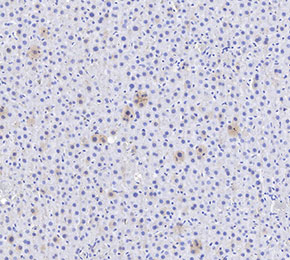 Immunohistochemical analysis of formalin fixed paraffin embedded rat liver tissue with F1534 at 1:100 dilution.
当該製品は品切れ状态で、メールアドレスをご教示いただければ、お客様に返信いたします。
代表番号: 045-509-1970|電子メール:sales@selleck.co.jp
使用情報
| Dilution |
|---|
|
| Application |
|---|
| IHC, ELISA |
| Source |
|---|
| Mouse Monoclonal Antibody |
| Reactivity |
|---|
| Nucleic Acid |
| Storage Buffer |
|---|
| PBS, pH 7.2+50% Glycerol+0.05% BSA+0.01% NaN3 |
| Storage (from the date of receipt) |
|---|
| -20°C (avoid freeze-thaw cycles), 2 years |
| ポジティブコントロール | Rat liver tissue; Rat brain tissue; Rat femoral tissue; Mouse back skin tissue; Mouse inflamed colon tissue; Mouse hepatocytes cells |
|---|---|
| ネガティブコントロール |
プロトコール
| IHC |
|---|
Experimental Protocol:
Deparaffinization/Rehydration
1. Deparaffinize/hydrate sections:
2. Incubate sections in three washes of xylene for 5 min each.
3. Incubate sections in two washes of 100% ethanol for 10 min each.
4. Incubate sections in two washes of 95% ethanol for 10 min each.
5. Wash sections two times in dH2O for 5 min each.
6.Antigen retrieval: For Citrate: Heat slides in a microwave submersed in 1X citrate unmasking solution until boiling is initiated; continue with 10 min at a sub-boiling temperature (95°-98°C). Cool slides on bench top for 30 min.
Staining
1. Wash sections in dH2O three times for 5 min each.
2. Incubate sections in 3% hydrogen peroxide for 10 min.
3. Wash sections in dH2O two times for 5 min each.
4. Wash sections in wash buffer for 5 min.
5. Block each section with 100–400 µl of blocking solution for 1 hr at room temperature.
6. Remove blocking solution and add 100–400 µl primary antibody diluent in to each section. Incubate overnight at 4°C.
7. Remove antibody solution and wash sections with wash buffer three times for 5 min each.
8. Cover section with 1–3 drops HRPas needed. Incubate in a humidified chamber for 30 min at room temperature.
9. Wash sections three times with wash buffer for 5 min each.
10. Add DAB Chromogen Concentrate to DAB Diluent and mix well before use.
11. Apply 100–400 µl DAB to each section and monitor closely. 1–10 min generally provides an acceptable staining intensity.
12. Immerse slides in dH2O.
13. If desired, counterstain sections with hematoxylin.
14. Wash sections in dH2O two times for 5 min each.
15. Dehydrate sections: Incubate sections in 95% ethanol two times for 10 sec each; Repeat in 100% ethanol, incubating sections two times for 10 sec each; Repeat in xylene, incubating sections two times for 10 sec each.
16. Mount sections with coverslips and mounting medium.
|
生物学的記述
| Specificity |
|---|
DNA/RNA Damage Antibody (Mouse mAb) [D16E12] detects DNA/RNA damage. |
| Clone |
|---|
| D16E12 |
| Synonym(s) |
|---|
| 7,8-Dihydro-8-oxo-2'-deoxyguanosine, 7,8-Dihydro-8-oxodeoxyguanosine, 7,8-Dihydro-8-oxoguanine, 8-Hydroxy-2'-deoxyguanosine, 8-Hydroxydeoxyguanosine, 8-OH-dG, 8-Oxo-G, 8-Oxo-dG, 8-Oxo-guanosine, Oxo-8-Gua, 8-oxo-Gua, OH8Gua |
| Background |
|---|
8-Oxoguanine, formed when reactive oxygen species react at the C8 position of guanine within either DNA or RNA, adopts two distinct pairing geometries depending on its glycosidic bond conformation: in the anti conformation it pairs with cytosine as in unmodified guanine, while in the syn conformation it uses a Hoogsteen edge to mispair with adenine, and this dual pairing capacity is the direct chemical basis for its mutagenic potential. Unrepaired 8-oxoguanine that has mispaired with adenine produces a G-to-T transversion, equivalent to C-to-A on the complementary strand, once DNA replication proceeds across the lesion, making 8-oxoguanine one of the most common oxidative mutagenic base lesions in the genome. Repair of this lesion proceeds through the base excision repair pathway, initiated when the bifunctional glycosylase OGG1 recognizes 8-oxoguanine paired with cytosine, cleaves the N-glycosidic bond to excise the damaged base, and performs a beta-elimination reaction that incises the phosphodiester backbone at the resulting apurinic site; the nick is then processed by APE1 and completed through short-patch or long-patch base excision repair. When 8-oxoguanine has already mispaired with adenine before repair occurs, a parallel glycosylase, MUTYH, recognizes this 8-oxoguanine-adenine mismatch, excises the inserted adenine rather than the oxidized guanine itself, and hands off to APE1 to complete MUTYH-initiated base excision repair, restoring the opportunity for correct cytosine insertion opposite the lesion. A third layer of defense operates at the nucleotide pool level, where MTH1 hydrolyzes oxidized guanine triphosphate before it can be incorporated into DNA by polymerases, preventing mutagenesis that would otherwise arise from direct incorporation of an already oxidized nucleotide rather than from in situ oxidation of genomic DNA. 8-oxoguanine also functions as an epigenetic signal: local reactive oxygen species generated during TET1-mediated DNA demethylation induce 8-oxoguanine formation at CpG islands, and the resulting 8-oxoguanine-OGG1 complex recruits repressive chromatin machinery, including DNA methyltransferases, to drive chromatin condensation and gene silencing at the damaged site. In RNA, the same oxidized base, denoted o8G, compromises translational fidelity and coding capacity, causes ribosome stalling and abortive protein products, and is subject to clearance through RNA decay pathways, extending 8-oxoguanine's functional relevance from mutagenesis and epigenetic regulation into post-transcriptional quality control, with accumulation of unrepaired 8-oxoguanine in either nucleic acid linked to aging, neurodegeneration, and cancer. |
| References |
|---|
技術サポート
ストックの作り方、阻害剤の保管方法、細胞実験や動物実験の際に注意すべき点など、製品を取扱う時に問い合わせが多かった質問に対しては取扱説明書でお答えしています。
他に質問がある場合は、お気軽にお問い合わせください。
* 必須

納期 国内在庫品:受注日の翌日(15時までの受注分) *北海道、九州、沖縄への配送は受注日より2日以上 を要する場合あり 海外在庫品:受注後1〜2週間