
- 阻害剤
- 研究分野別
- PI3K/Akt/mTOR
- Epigenetics
- Methylation
- Immunology & Inflammation
- Protein Tyrosine Kinase
- Angiogenesis
- Apoptosis
- Autophagy
- ER stress & UPR
- JAK/STAT
- MAPK
- Cytoskeletal Signaling
- Cell Cycle
- TGF-beta/Smad
- 化合物ライブラリー
- 抗体
- 新製品
- お問い合わせ

PREX1 Antibody (Rabbit mAb) [J20N16]
CatNo: F7369
Application:
Reactivity:
-
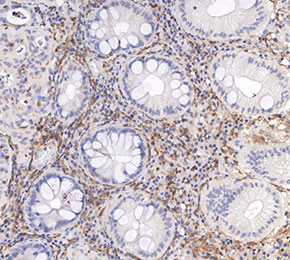 Immunohistochemical analysis of formalin fixed paraffin embedded human lung cancer tissue with F7369 at 1:150 dilution.
当該製品は品切れ状态で、メールアドレスをご教示いただければ、お客様に返信いたします。
代表番号: 045-509-1970|電子メール:sales@selleck.co.jp
使用情報
| Dilution |
|---|
|
| Application |
|---|
| IHC |
| Source |
|---|
| Rabbit Monoclonal Antibody |
| Reactivity |
|---|
| Human |
| Storage Buffer |
|---|
| PBS, pH 7.2+50% Glycerol+0.05% BSA+0.01% NaN3 |
| Storage (from the date of receipt) |
|---|
| -20°C (avoid freeze-thaw cycles), 2 years |
| Predicted MW Observed MW |
|---|
| 186 kDa 190 kDa, 110 kDa |
| *なぜ予測分子量と実際の分子量が異なるのか? 下記の原因により、実際の分子量が予測と異なる:タンパク質の翻訳後修飾(リン酸化/糖鎖付加),スプライシングバリアント,イソフォーム,相対的な電荷,ポリマー。 |
| ポジティブコントロール | Human colon carcinoma; Human lung carcinoma; Human lymphoma; Human melanoma; T-47D cells |
|---|---|
| ネガティブコントロール | MCF 10A cells |
プロトコール
| IHC |
|---|
Experimental Protocol:
Deparaffinization/Rehydration
1. Deparaffinize/hydrate sections:
2. Incubate sections in three washes of xylene for 5 min each.
3. Incubate sections in two washes of 100% ethanol for 10 min each.
4. Incubate sections in two washes of 95% ethanol for 10 min each.
5. Wash sections two times in dH2O for 5 min each.
6.Antigen retrieval: For Citrate: Heat slides in a microwave submersed in 1X citrate unmasking solution until boiling is initiated; continue with 10 min at a sub-boiling temperature (95°-98°C). Cool slides on bench top for 30 min.
Staining
1. Wash sections in dH2O three times for 5 min each.
2. Incubate sections in 3% hydrogen peroxide for 10 min.
3. Wash sections in dH2O two times for 5 min each.
4. Wash sections in wash buffer for 5 min.
5. Block each section with 100–400 µl of blocking solution for 1 hr at room temperature.
6. Remove blocking solution and add 100–400 µl primary antibody diluent in to each section. Incubate overnight at 4°C.
7. Remove antibody solution and wash sections with wash buffer three times for 5 min each.
8. Cover section with 1–3 drops HRPas needed. Incubate in a humidified chamber for 30 min at room temperature.
9. Wash sections three times with wash buffer for 5 min each.
10. Add DAB Chromogen Concentrate to DAB Diluent and mix well before use.
11. Apply 100–400 µl DAB to each section and monitor closely. 1–10 min generally provides an acceptable staining intensity.
12. Immerse slides in dH2O.
13. If desired, counterstain sections with hematoxylin.
14. Wash sections in dH2O two times for 5 min each.
15. Dehydrate sections: Incubate sections in 95% ethanol two times for 10 sec each; Repeat in 100% ethanol, incubating sections two times for 10 sec each; Repeat in xylene, incubating sections two times for 10 sec each.
16. Mount sections with coverslips and mounting medium.
|
生物学的記述
| Specificity |
|---|
| PREX1 Antibody (Rabbit mAb) [J20N16] detects endogenous levels of total PREX1 protein. |
| Uniprot ID |
|---|
| Q8TCU6 |
| Clone |
|---|
| J20N16 |
| Synonym(s) |
|---|
| KIAA1415 | P-Rex1 | Phosphatidylinositol 3 | 4 | 5-trisphosphate-dependent Rac exchanger 1 protein | phosphatidylinositol-3 | 4 | 5-trisphosphate dependent Rac exchange factor 1 | phosphatidylinositol-3 | 4 | 5-trisphosphate-dependent Rac exchange factor 1 | PIP3 dependent Rac exchange factor 1 | PREX1 | PtdIns(3 | 4 | 5)-dependent Rac exchanger 1 |
| Background |
|---|
| PREX1, also known as phosphatidylinositol‑3,4,5‑trisphosphate‑dependent Rac exchanger 1, belongs to the Dbl family of Rho‑type guanine nucleotide exchange factors and functions as a Rac‑directed signal integrator downstream of phosphoinositide 3‑kinase and G protein‑coupled receptors. The protein contains an N‑terminal Dbl‑homology catalytic domain paired with a pleckstrin homology domain that senses phosphatidylinositol‑3,4,5‑trisphosphate, flanked by tandem DEP domains and C‑terminal PDZ and IP4P‑like regions that assemble regulatory and effector interactions and support long‑range allosteric control across a two‑layered autoinhibited architecture. Binding of phosphatidylinositol‑3,4,5‑trisphosphate to the pleckstrin homology domain and engagement of Gβγ subunits at defined regulatory surfaces release intramolecular restraints within PREX1, expose the Dbl‑homology active site, and permit efficient GDP–GTP exchange on Rac‑family GTPases, which elevates Rac‑GTP levels and couples receptor inputs to the core Rho GTPase network. Activated Rac then links PREX1 output to downstream effectors such as p21‑activated kinases and other Rac‑responsive kinases that remodel the actin cytoskeleton, regulate lamellipodia dynamics, and adjust adhesion complexes, placing PREX1 as a central controller of directed migration, invasion, and cell–matrix interactions in contexts where G protein‑coupled receptor and receptor tyrosine kinase signals converge. Structural analysis of full‑length PREX1 shows that the catalytic module packs against distal domains in an autoinhibitory configuration and that coincident lipid and Gβγ binding induces large conformational rearrangements across both layers of the molecule, aligning the Dbl‑homology domain with Rac substrates and stabilizing an active signaling conformation at the plasma membrane. Rac activation driven by PREX1 contributes to pathways that connect to ERK signaling and other mitogenic cascades, linking this exchange factor to regulation of proliferation and survival in addition to motility, and placing it within broader signaling circuits that integrate chemokine receptors, sphingosine‑1‑phosphate receptors, and growth factor receptors. Elevated PREX1 expression and activation are associated with increased invasive behavior and metastatic potential in cancers such as breast cancer, prostate cancer, melanoma, and glioblastoma, where PREX1–Rac signaling shapes cytoskeletal organization, directional migration, and matrix invasion, and where Rac‑dependent kinase outputs feed into transcriptional programs that support tumor progression. |
| References |
|---|
技術サポート
ストックの作り方、阻害剤の保管方法、細胞実験や動物実験の際に注意すべき点など、製品を取扱う時に問い合わせが多かった質問に対しては取扱説明書でお答えしています。
他に質問がある場合は、お気軽にお問い合わせください。
* 必須

納期 国内在庫品:受注日の翌日(15時までの受注分) *北海道、九州、沖縄への配送は受注日より2日以上 を要する場合あり 海外在庫品:受注後1〜2週間