
- 阻害剤
- 研究分野別
- PI3K/Akt/mTOR
- Epigenetics
- Methylation
- Immunology & Inflammation
- Protein Tyrosine Kinase
- Angiogenesis
- Apoptosis
- Autophagy
- ER stress & UPR
- JAK/STAT
- MAPK
- Cytoskeletal Signaling
- Cell Cycle
- TGF-beta/Smad
- 化合物ライブラリー
- 抗体
- 新製品
- お問い合わせ

TBC1D7 Antibody (Rabbit mAb) [D5H17]
Catalog No.: F5142
Application:
Reactivity:
-
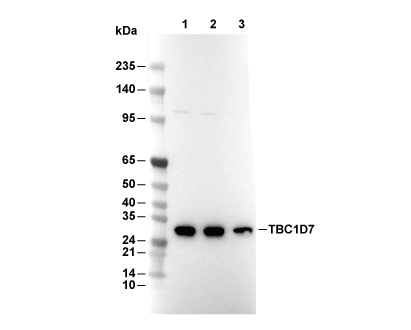 Lane 1: 3T3, Lane 2: Hela, Lane 3: C2C12
キーポイント
WB
転写条件(ウェット): 200 mA, 60 min。
転写条件(ウェット): 200 mA, 60 min。
使用情報
| Dilution |
|---|
|
| Application |
|---|
| WB, IP |
| Source |
|---|
| Rabbit Monoclonal Antibody |
| Reactivity |
|---|
| Human, Mouse, Rat |
| Storage Buffer |
|---|
| PBS, pH 7.2+50% Glycerol+0.05% BSA+0.01% NaN3 |
| Storage (from the date of receipt) |
|---|
| -20°C (avoid freeze-thaw cycles), 2 years |
| Predicted MW |
|---|
| 30 kDa |
| ポジティブコントロール | NIH/3T3 cells; HeLa cells; C2C12 cells |
|---|---|
| ネガティブコントロール |
プロトコール
| WB |
|---|
Experimental Protocol:
Sample preparation
1. Tissue: Lyse the tissue sample by adding an appropriate volume of ice-cold RIPA/NP-40 Lysis Buffer (containing Protease Inhibitor Cocktail),and homogenize the tissue at a low temperature or lyse it by sonication on ice, then incubate on ice for 30 minutes. 2. Adherent cell: Aspirate the culture medium and wash the cells with ice-cold PBS twice. Lyse the cells by adding an appropriate volume of RIPA/NP-40 Lysis Buffer (containing Protease Inhibitor Cocktail), sonicate to lyse the cells, and incubate on ice for 30 minutes. 3. Suspension cell: Transfer the culture medium to a pre-cooled centrifuge tube. Centrifuge and aspirate the supernatant. Wash the cells with ice-cold PBS twice. Lyse the cells by adding an appropriate volume of RIPA/NP-40 Lysis Buffer (containing Protease Inhibitor Cocktail), sonicate to lyse the cells, and incubate on ice for 30 minutes. 4. Place the lysate into a pre-cooled microcentrifuge tube. Centrifuge at 4°C for 15 min. Collect the supernatant;
5. Remove a small volume of lysate to determine the protein concentration;
6. Combine the lysate with protein loading buffer. Boil 20 µL sample under 95-100°C for 5 min. Centrifuge for 5 min after cool down on ice.
Electrophoretic separation
1. According to the concentration of extracted protein, load appropriate amount of protein sample and marker onto SDS-PAGE gels for electrophoresis. Recommended separating gel (lower gel) concentration: 10%. Reference Table for Selecting SDS-PAGE Separation Gel Concentrations 2. Power up 80V for 30 minutes. Then the power supply is adjusted (110 V~150 V), the Marker is observed, and the electrophoresis can be stopped when the indicator band of the predyed protein Marker where the protein is located is properly separated. (Note that the current should not be too large when electrophoresis, too large current (more than 150 mA) will cause the temperature to rise, affecting the result of running glue. If high currents cannot be avoided, an ice bath can be used to cool the bath.)
Transfer membrane
1. Take out the converter, soak the clip and consumables in the pre-cooled converter;
2. Activate PVDF membrane with methanol for 1 min and rinse with transfer buffer;
3. Install it in the order of "black edge of clip - sponge - filter paper - filter paper - glue -PVDF membrane - filter paper - filter paper - sponge - white edge of clip"; 4. The protein was electrotransferred to PVDF membrane. ( 0.45 µm PVDF membrane is recommended ) Reference Table for Selecting PVDF Membrane Pore Size Specifications Recommended conditions for wet transfer: 200 mA, 60 min. ( Note that the transfer conditions can be adjusted according to the protein size. For high-molecular-weight proteins, a higher current and longer transfer time are recommended. However, ensure that the transfer tank remains at a low temperature to prevent gel melting.)
Block
1. After electrotransfer, wash the film with TBST at room temperature for 5 minutes;
2. Incubate the film in the blocking solution for 1 hour at room temperature;
3. Wash the film with TBST for 3 times, 5 minutes each time.
Antibody incubation
1. Use 5% skim milk powder to prepare the primary antibody working liquid (recommended dilution ratio for primary antibody 1:1000), gently shake and incubate with the film at 4°C overnight; 2. Wash the film with TBST 3 times, 5 minutes each time;
3. Add the secondary antibody to the blocking solution and incubate with the film gently at room temperature for 1 hour;
4. After incubation, wash the film with TBST 3 times for 5 minutes each time.
Antibody staining
1. Add the prepared ECL luminescent substrate (or select other color developing substrate according to the second antibody) and mix evenly;
2. Incubate with the film for 1 minute, remove excess substrate (keep the film moist), wrap with plastic film, and expose in the imaging system. |
生物学的記述
| Specificity |
|---|
| TBC1D7 Antibody (Rabbit mAb) [D5H17] detects endogenous levels of total TBC1D7 protein. |
| タンパク質の局在 |
|---|
| 細胞質、細胞質小胞、リソソーム、細胞内膜系 |
| Uniprot ID |
|---|
| Q9P0N9 |
| Clone |
|---|
| D5H17 |
| Synonym(s) |
|---|
| TBC1 domain family member 7; Cell migration-inducing protein 23; TBC1D7; TBC7; HSPC239 |
| Background |
|---|
| TBC1D7, a non-canonical member of the TBC/RabGAP protein family that lacks the typical catalytic arginine and glutamine fingers, serves as the third essential subunit of the TSC1-TSC2 complex, known as the TSC complex. By binding to the C-terminal coiled-coil domain of TSC1, TBC1D7 stabilizes the heterodimerization of TSC1 and TSC2 and enhances the Rheb-GAP activity required for effective mTORC1 suppression. TBC1D7 adopts a compact, globular fold composed of fifteen α-helices, with conserved residues on α4 and α5 mediating interaction with TSC1 through a 2:2 heterotetramer interface, where the C-terminal tip of α4 crosslinks adjacent TSC1 molecules, reinforcing the rigidity and stability of the complex. Phosphorylation of Ser124 by Akt enables recruitment of 14-3-3 proteins, further stabilizing TBC1D7. TBC1D7 is crucial for maintaining the integrity of the TSC complex, preventing TSC1 dissociation, and amplifying TSC2-mediated Rheb-GTP hydrolysis, thereby dampening mTORC1-driven anabolic pathways such as protein synthesis and cell growth and limiting lysosome-based mTORC1 activation during nutrient stress. TBC1D7 also fine-tunes autophagy, insulin and PI3K signaling responses, and systemic growth, with some functions occurring independently of the TSC complex. Loss of TBC1D7 destabilizes the TSC1-TSC2 complex, increases Rheb-GTP and mTORC1 activity, leads to cell enlargement, and delays autophagy, while mutations are linked to intellectual disability and abnormal brain growth due to mTORC1 hyperactivation. Disease associations include the augmentation of tuberous sclerosis complex and various neurodevelopmental disorders, with TBC1D7 deficiency mimicking the effects of TSC1 or TSC2 loss under nutrient-limiting conditions. |
| References |
|---|
技術サポート
ストックの作り方、阻害剤の保管方法、細胞実験や動物実験の際に注意すべき点など、製品を取扱う時に問い合わせが多かった質問に対しては取扱説明書でお答えしています。
他に質問がある場合は、お気軽にお問い合わせください。
* 必須

納期 国内在庫品:受注日の翌日(15時までの受注分) *北海道、九州、沖縄への配送は受注日より2日以上 を要する場合あり 海外在庫品:受注後1〜2週間