
- 阻害剤
- 研究分野別
- PI3K/Akt/mTOR
- Epigenetics
- Methylation
- Immunology & Inflammation
- Protein Tyrosine Kinase
- Angiogenesis
- Apoptosis
- Autophagy
- ER stress & UPR
- JAK/STAT
- MAPK
- Cytoskeletal Signaling
- Cell Cycle
- TGF-beta/Smad
- 化合物ライブラリー
- 抗体
- 新製品
- お問い合わせ

TWIST1 Antibody (Rabbit mAb) [M21K22]
CatNo: F5951
Application:
Reactivity:
-
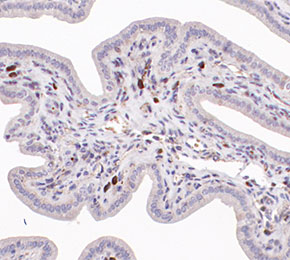 Immunohistochemical analysis of formalin fixed paraffin embedded mouse uterine tissue with F5951 at 1:250 dilution.
当該製品は品切れ状态で、メールアドレスをご教示いただければ、お客様に返信いたします。
代表番号: 045-509-1970|電子メール:sales@selleck.co.jp
使用情報
| Dilution |
|---|
|
| Application |
|---|
| IHC |
| Source |
|---|
| Rabbit Monoclonal Antibody |
| Reactivity |
|---|
| Mouse |
| Storage Buffer |
|---|
| PBS, pH 7.2+50% Glycerol+0.05% BSA+0.01% NaN3 |
| Storage (from the date of receipt) |
|---|
| -20°C (avoid freeze-thaw cycles), 2 years |
| Predicted MW |
|---|
| 21 kDa |
| ポジティブコントロール | Mouse ovary tissue; CT26 syngeneic tumor tissue; GL-261 syngeneic tumor tissue; Renca syngeneic tumor tissue; 4T1 syngeneic mammary tumor tissue; LL/2 syngeneic tumor tissue; SH-SY5Y cells |
|---|---|
| ネガティブコントロール | HeLa cells |
プロトコール
| IHC |
|---|
Experimental Protocol:
Deparaffinization/Rehydration
1. Deparaffinize/hydrate sections:
2. Incubate sections in three washes of xylene for 5 min each.
3. Incubate sections in two washes of 100% ethanol for 10 min each.
4. Incubate sections in two washes of 95% ethanol for 10 min each.
5. Wash sections two times in dH2O for 5 min each.
6.Antigen retrieval: For Citrate: Heat slides in a microwave submersed in 1X citrate unmasking solution until boiling is initiated; continue with 10 min at a sub-boiling temperature (95°-98°C). Cool slides on bench top for 30 min.
Staining
1. Wash sections in dH2O three times for 5 min each.
2. Incubate sections in 3% hydrogen peroxide for 10 min.
3. Wash sections in dH2O two times for 5 min each.
4. Wash sections in wash buffer for 5 min.
5. Block each section with 100–400 µl of blocking solution for 1 hr at room temperature.
6. Remove blocking solution and add 100–400 µl primary antibody diluent in to each section. Incubate overnight at 4°C.
7. Remove antibody solution and wash sections with wash buffer three times for 5 min each.
8. Cover section with 1–3 drops HRPas needed. Incubate in a humidified chamber for 30 min at room temperature.
9. Wash sections three times with wash buffer for 5 min each.
10. Add DAB Chromogen Concentrate to DAB Diluent and mix well before use.
11. Apply 100–400 µl DAB to each section and monitor closely. 1–10 min generally provides an acceptable staining intensity.
12. Immerse slides in dH2O.
13. If desired, counterstain sections with hematoxylin.
14. Wash sections in dH2O two times for 5 min each.
15. Dehydrate sections: Incubate sections in 95% ethanol two times for 10 sec each; Repeat in 100% ethanol, incubating sections two times for 10 sec each; Repeat in xylene, incubating sections two times for 10 sec each.
16. Mount sections with coverslips and mounting medium.
|
生物学的記述
| Specificity |
|---|
| TWIST1 Antibody (Rabbit mAb) [M21K22] detects endogenous levels of total TWIST1 protein. |
| タンパク質の局在 |
|---|
| 細胞核 |
| Uniprot ID |
|---|
| Q15672 |
| Clone |
|---|
| M21K22 |
| Synonym(s) |
|---|
| ACS3; B-HLH DNA binding protein; BHLHA38; BPES2; BPES3; Class A basic helix-loop-helix protein 38; CRS; CRS1; CSO; H-twist; SCS; SWCOS; TWIST; twist homolog 1 (Drosophila); TWIST homolog of drosophila; Twist-related protein 1; TWIST1; TWST1 |
| Background |
|---|
| TWIST1 belongs to the class B basic helix-loop-helix family of transcription factors and functions as a master regulator of mesoderm formation and mesenchymal differentiation during embryonic morphogenesis, acting through its bHLH domain to bind E-box regulatory sequences on target gene promoters. The protein forms both homodimers and heterodimers, with the heterodimer between TWIST1 and the class A bHLH factor E12 representing the predominant transcriptionally active complex driving prometastatic gene programs, while homodimerization with itself or with other class B partners such as HAND2 produces functionally distinct outcomes; dimer choice within the cell is governed largely by the relative availability of these bHLH partners and by inhibitory Id proteins, which sequester E12 through competitive binding and thereby actively reshape the pool of TWIST1 complexes able to engage DNA. Heterodimerization with E12 depends on coordinated phosphorylation, since a phosphorylation-deficient TWIST1 mutant at serine 68 selectively impairs TWIST1-E12 heterodimer formation and downstream target gene induction while leaving TWIST1 homodimer formation intact, demonstrating that phosphorylation state functions as a molecular switch controlling which dimer species predominates and, consequently, which transcriptional program is executed. Once assembled, the TWIST1-E12 heterodimer drives epithelial-mesenchymal transition by directly repressing E-cadherin expression, a repression achieved through recruitment of the Mi-2/NuRD nucleosome remodeling and deacetylase complex via interactions with MTA2 and RbAp46, coupling TWIST1 DNA binding to active chromatin remodeling rather than passive transcriptional interference. TWIST1 additionally engages the TWIST-box domain, a separate conserved region that binds the runt domain of RUNX2 and inhibits its transactivation activity, while TWIST1 also directly represses RUNX2 expression, together restraining premature osteoblast differentiation and positioning TWIST1 as a checkpoint over osteogenic commitment during skeletal development. In cancer contexts, TWIST1-driven dissemination of epithelial cells can proceed while cytokeratin expression and epithelial identity are preserved, with TWIST1 instead reprogramming extracellular matrix and cell-matrix adhesion genes rather than cell-cell adhesion genes, indicating that TWIST1 promotes tumor cell dissemination through a mechanism broader than E-cadherin loss alone. TWIST1 expression is elevated across breast, liver, prostate, and gastric cancers and is upregulated by multiple upstream inputs including STAT3, HIF-1α, and NF-κB, correlating with invasive and metastatic phenotypes, while heterozygous loss-of-function mutations affecting the bHLH domain cause Saethre-Chotzen syndrome, a craniosynostosis disorder, establishing TWIST1 dosage and dimerization fidelity as critical parameters across both developmental and oncogenic contexts. |
| References |
|---|
技術サポート
ストックの作り方、阻害剤の保管方法、細胞実験や動物実験の際に注意すべき点など、製品を取扱う時に問い合わせが多かった質問に対しては取扱説明書でお答えしています。
他に質問がある場合は、お気軽にお問い合わせください。
* 必須

納期 国内在庫品:受注日の翌日(15時までの受注分) *北海道、九州、沖縄への配送は受注日より2日以上 を要する場合あり 海外在庫品:受注後1〜2週間