
- 阻害剤
- 研究分野別
- PI3K/Akt/mTOR
- Epigenetics
- Methylation
- Immunology & Inflammation
- Protein Tyrosine Kinase
- Angiogenesis
- Apoptosis
- Autophagy
- ER stress & UPR
- JAK/STAT
- MAPK
- Cytoskeletal Signaling
- Cell Cycle
- TGF-beta/Smad
- 化合物ライブラリー
- 抗体
- 新製品
- お問い合わせ

ADX Antibody (Rabbit mAb) [H7P21]
CatNo: F5568
Application:
Reactivity:
-
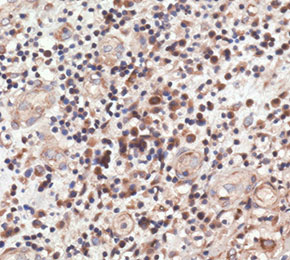 Immunohistochemical analysis of formalin fixed paraffin embedded human testicular tissue with F5568 at 1:500 dilution.
当該製品は品切れ状态で、メールアドレスをご教示いただければ、お客様に返信いたします。
代表番号: 045-509-1970|電子メール:sales@selleck.co.jp
使用情報
| Dilution |
|---|
|
| Application |
|---|
| IHC |
| Source |
|---|
| Rabbit Monoclonal Antibody |
| Reactivity |
|---|
| Human, Mouse |
| Storage Buffer |
|---|
| PBS, pH 7.2+50% Glycerol+0.05% BSA+0.01% NaN3 |
| Storage (from the date of receipt) |
|---|
| -20°C (avoid freeze-thaw cycles), 2 years |
| Predicted MW |
|---|
| 19 kDa |
| ポジティブコントロール | Mouse adrenal gland; Human adrenal gland tissue; Human testis tissue; Human kidney tissue; Mouse testis tissue; Mouse kidney tissue; Mouse adrenal gland tissue; His-tagged human ADX recombinant protein |
|---|---|
| ネガティブコントロール | Mouse cerebrum tissue; Human cerebrum tissue |
プロトコール
| IHC |
|---|
Experimental Protocol:
Deparaffinization/Rehydration
1. Deparaffinize/hydrate sections:
2. Incubate sections in three washes of xylene for 5 min each.
3. Incubate sections in two washes of 100% ethanol for 10 min each.
4. Incubate sections in two washes of 95% ethanol for 10 min each.
5. Wash sections two times in dH2O for 5 min each.
6.Antigen retrieval: For Citrate: Heat slides in a microwave submersed in 1X citrate unmasking solution until boiling is initiated; continue with 10 min at a sub-boiling temperature (95°-98°C). Cool slides on bench top for 30 min.
Staining
1. Wash sections in dH2O three times for 5 min each.
2. Incubate sections in 3% hydrogen peroxide for 10 min.
3. Wash sections in dH2O two times for 5 min each.
4. Wash sections in wash buffer for 5 min.
5. Block each section with 100–400 µl of blocking solution for 1 hr at room temperature.
6. Remove blocking solution and add 100–400 µl primary antibody diluent in to each section. Incubate overnight at 4°C.
7. Remove antibody solution and wash sections with wash buffer three times for 5 min each.
8. Cover section with 1–3 drops HRPas needed. Incubate in a humidified chamber for 30 min at room temperature.
9. Wash sections three times with wash buffer for 5 min each.
10. Add DAB Chromogen Concentrate to DAB Diluent and mix well before use.
11. Apply 100–400 µl DAB to each section and monitor closely. 1–10 min generally provides an acceptable staining intensity.
12. Immerse slides in dH2O.
13. If desired, counterstain sections with hematoxylin.
14. Wash sections in dH2O two times for 5 min each.
15. Dehydrate sections: Incubate sections in 95% ethanol two times for 10 sec each; Repeat in 100% ethanol, incubating sections two times for 10 sec each; Repeat in xylene, incubating sections two times for 10 sec each.
16. Mount sections with coverslips and mounting medium.
|
生物学的記述
| Specificity |
|---|
| ADX Antibody (Rabbit mAb) [H7P21] detects endogenous levels of total ADX protein. |
| タンパク質の局在 |
|---|
| ミトコンドリア |
| Uniprot ID |
|---|
| P10109 |
| Clone |
|---|
| H7P21 |
| Synonym(s) |
|---|
| ADX, FDX1, Adrenal ferredoxin, Ferredoxin-1, Hepatoredoxin |
| Background |
|---|
| Adrenodoxin, encoded by FDX1 and also designated ADX, belongs to the [2Fe-2S] ferredoxin family of small iron-sulfur electron-shuttle proteins and exists in humans alongside a structurally similar paralog, FDX2, with which it shares high sequence conservation but distinct functional targets. Adrenodoxin loosely associates with the inner mitochondrial membrane and receives electrons from the flavoprotein ferredoxin reductase, which itself accepts electrons from NADPH, and adrenodoxin then forms a transient one-to-one complex with its downstream partner before dissociating and reforming an analogous complex with the next redox acceptor, functioning as a diffusible electron shuttle rather than a fixed component of a stable multi-protein assembly. This shuttling mechanism delivers electrons to mitochondrial type I cytochrome P450 enzymes, most centrally CYP11A1, the cholesterol side-chain cleavage enzyme, which requires two electrons from adrenodoxin for each of its three sequential monooxygenase reactions that convert cholesterol first to 22R-hydroxycholesterol, then to 20α,22R-dihydroxycholesterol, and finally cleave the C20-C22 bond to yield pregnenolone, the first and rate-limiting step of steroid hormone biosynthesis. Beyond CYP11A1, adrenodoxin also donates electrons to CYP11B1 and CYP11B2, supporting later hydroxylation steps required for cortisol and aldosterone synthesis, and its physical interaction with these P450 enzymes depends on overlapping negatively charged surface residues that engage complementary positive charges on both the P450 partner and ferredoxin reductase, meaning adrenodoxin uses the same molecular surface to interact sequentially with both redox partners during the shuttle cycle. Functional specificity between adrenodoxin and FDX2 is determined by short conserved sequence motifs rather than by gross structural differences between the two ferredoxins, and adrenodoxin is now understood to support additional pathways beyond steroidogenesis, donating electrons that initiate heme a formation through COX15 and that kickstart the radical chain reaction carried out by lipoyl synthase during lipoyl cofactor biosynthesis, a pathway feeding TCA cycle enzyme function, while FDX2 rather than adrenodoxin handles iron-sulfur cluster protein maturation. Adrenodoxin is expressed most highly in the adrenal cortex, consistent with its central steroidogenic role, and defects along the ferredoxin-ferredoxin reductase-cytochrome P450 electron transfer chain produce disorders of steroidogenesis marked by cortisol deficiency and abnormal androgen or mineralocorticoid output, positioning adrenodoxin as a defined electron-donor node whose disruption connects directly to congenital adrenal hyperplasia-type presentations and broader mitochondrial redox dysfunction. |
| References |
|---|
技術サポート
ストックの作り方、阻害剤の保管方法、細胞実験や動物実験の際に注意すべき点など、製品を取扱う時に問い合わせが多かった質問に対しては取扱説明書でお答えしています。
他に質問がある場合は、お気軽にお問い合わせください。
* 必須

納期 国内在庫品:受注日の翌日(15時までの受注分) *北海道、九州、沖縄への配送は受注日より2日以上 を要する場合あり 海外在庫品:受注後1〜2週間