
- 阻害剤
- 研究分野別
- PI3K/Akt/mTOR
- Epigenetics
- Methylation
- Immunology & Inflammation
- Protein Tyrosine Kinase
- Angiogenesis
- Apoptosis
- Autophagy
- ER stress & UPR
- JAK/STAT
- MAPK
- Cytoskeletal Signaling
- Cell Cycle
- TGF-beta/Smad
- 化合物ライブラリー
- 抗体
- 新製品
- お問い合わせ

Atropine sulfate monohydrate
Atropine sulfate monohydrateは、ムスカリン性アセチルコリン受容体の競合的拮抗薬であり、手術前に唾液および気道分泌物の産生を減少させるために使用されます。
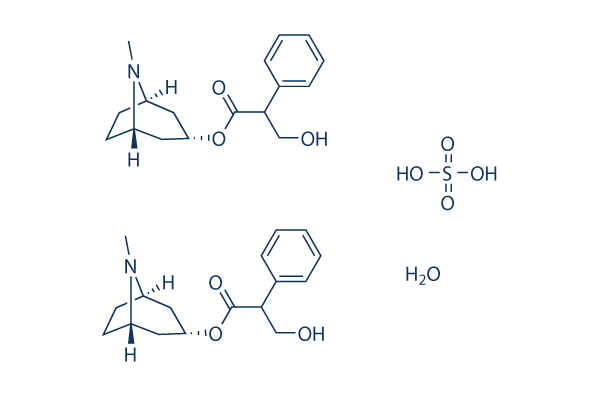
CAS No. 5908-99-6
文献中Selleckの製品使用例(2)
製品安全説明書
現在のバッチを見る:
純度:
99.66%
99.66
Atropine sulfate monohydrate関連製品
ADC Cytotoxin阻害剤の選択性比較
生物活性
| 製品説明 | Atropine sulfate monohydrateは、ムスカリン性アセチルコリン受容体の競合的拮抗薬であり、手術前に唾液および気道分泌物の産生を減少させるために使用されます。 | ||
|---|---|---|---|
| Targets |
|
| In Vitro | ||||
| In vitro | Atropine increases the release of the neurotransmitter dopamine into the superfusate in vitro at 100-500 mM and into the vitreous in vivo at 250 mg. Atropine induces spreading depression (SD) in the in vitro preparation. Atropine reduces the ERG b- and d-wave, leads to damped oscillations of RPE potentials, and reverses the ERG c-wave. Atropine suppresses myopia only at doses at which severe nonspecific side effects are observed in the retina. | |||
|---|---|---|---|---|
| In Vivo | ||
| In Vivo | Atropine (1.0 mg/kg, i.p.), but not methylatropine (1.0 mg/kg, i.p.), prevents the enhancement of retention induced by both doses of the anticholinesterase when given immediately after training in mice. Atropine administration effectively prevents bradycardia and second-degree heart block but induces pulsus alternans and hypertension in dogs. Atropine has no effect on handling-induced acetylcholine output in the presence of 10 nM neostigmine, but causes greater and longer increases in the presence of 100 nM and 1000 nM neostigmine in rats. Atropine not only blocks the rapid eye movement (REM) sleep increases induced by CGS but it also tends to decrease REM sleep compared to atropine preceding saline in rats. Atropine decreases the time to exhaustion by 67% in intact rats and by 96.2% in adrenodemedullated (ADM) and also reduces the exercise-induced pituitary prolactin (PRL) release in both intact (50%) and ADM rats (90%). | |
|---|---|---|
| NCT Number | Recruitment | Conditions | Sponsor/Collaborators | Start Date | Phases |
|---|---|---|---|---|---|
| NCT05667454 | RECRUITING | Progressive Myopia |
Erasmus Medical Center |
2022-12-19 | PHASE3 |
| NCT06765603 | NOT_YET_RECRUITING | Myopia |
Singapore National Eye Centre |
2025-02-01 | PHASE2 |
| NCT07095894 | RECRUITING | Myopia |
Jaeb Center for Health Research |
2026-06-01 | PHASE3 |
| NCT07567040 | RECRUITING | Myopia |
Ohio State University |
2026-05-27 | PHASE3 |
| NCT07434635 | RECRUITING | Eye Disorders |
University of California, San Francisco |
2026-03-10 | PHASE4 |
| NCT05815784 | ACTIVE_NOT_RECRUITING | Myopia |
Ann & Robert H Lurie Children's Hospital of Chicago |
2023-05-02 | PHASE2 |
|
化学情報
| 分子量 | 694.83 | 化学式 | 2(C17H23NO3).H2O.H2SO4 |
| CAS No. | 5908-99-6 | SDF | Download Atropine sulfate monohydrate SDFをダウンロードする |
| Smiles | CN1C2CCC1CC(C2)OC(=O)C(CO)C3=CC=CC=C3.CN1C2CCC1CC(C2)OC(=O)C(CO)C3=CC=CC=C3.O.OS(=O)(=O)O | ||
| 保管 | |||
|
In vitro |
DMSO : 139 mg/mL ( (200.04 mM); 吸湿したDMSOは溶解度を減少させます。新しいDMSOをご使用ください。) Water : 139 mg/mL Ethanol : 139 mg/mL |
モル濃度計算器 |
|
in vivo Add solvents to the product individually and in order. |
投与溶液組成計算機 | |||||
実験計算
投与溶液組成計算機(クリア溶液)
ステップ1:実験データを入力してください。(実験操作によるロスを考慮し、動物数を1匹分多くして計算・調製することを推奨します)
mg/kg
g
μL
匹
ステップ2:投与溶媒の組成を入力してください。(ロット毎に適した溶解組成が異なる場合があります。詳細については弊社までお問い合わせください)
% DMSO
%
% Tween 80
% ddH2O
%DMSO
%
計算結果:
投与溶媒濃度: mg/ml;
DMSOストック溶液調製方法: mg 試薬を μL DMSOに溶解する(濃度 mg/mL, 注:濃度が当該ロットのDMSO溶解度を超える場合はご連絡ください。 )
投与溶媒調製方法:Take μL DMSOストック溶液に μL PEG300,を加え、完全溶解後μL Tween 80,を加えて完全溶解させた後 μL ddH2O,を加え完全に溶解させます。
投与溶媒調製方法:μL DMSOストック溶液に μL Corn oil,を加え、完全溶解。
注意:1.ストック溶液に沈殿、混濁などがないことをご確認ください;
2.順番通りに溶剤を加えてください。次のステップに進む前に溶液に沈殿、混濁などがないことを確認してから加えてください。ボルテックス、ソニケーション、水浴加熱など物理的な方法で溶解を早めることは可能です。
技術サポート
ストックの作り方、阻害剤の保管方法、細胞実験や動物実験の際に注意すべき点など、製品を取扱う時に問い合わせが多かった質問に対しては取扱説明書でお答えしています。
他に質問がある場合は、お気軽にお問い合わせください。
* 必須

納期 国内在庫品:受注日の翌日(15時までの受注分) *北海道、九州、沖縄への配送は受注日より2日以上 を要する場合あり 海外在庫品:受注後1〜2週間