
- 阻害剤
- 研究分野別
- PI3K/Akt/mTOR
- Epigenetics
- Methylation
- Immunology & Inflammation
- Protein Tyrosine Kinase
- Angiogenesis
- Apoptosis
- Autophagy
- ER stress & UPR
- JAK/STAT
- MAPK
- Cytoskeletal Signaling
- Cell Cycle
- TGF-beta/Smad
- 化合物ライブラリー
- 抗体
- 新製品
- お問い合わせ

Ansamitocin p-3 (Maytansinol isobutyrate, NSC292222)
別名:Antibiotic C 15003P3
Ansamitocin p-3 (Maytansinol isobutyrate, NSC292222, Antibiotic C 15003P3) は、IC50 が 3.4 μM のチュブリン重合の強力な阻害剤です。
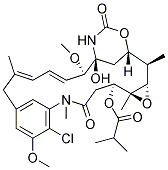
CAS No. 66584-72-3
製品安全説明書
現在のバッチを見る:
純度:
99.28%
99.28
Ansamitocin p-3 (Maytansinol isobutyrate, NSC292222)関連製品
ADC Cytotoxin阻害剤の選択性比較
生物活性
| 製品説明 | Ansamitocin p-3 (Maytansinol isobutyrate, NSC292222, Antibiotic C 15003P3) は、IC50 が 3.4 μM のチュブリン重合の強力な阻害剤です。 |
|---|---|
| 特性 | Ansamitocin p-3 does not inhibit the growth of bacteria, but very markedly inhibits the growth of eukaryotic organisms. |
| In Vitro | ||||
| In vitro |
Ansamitocin p-3 (Maytansinol isobutyrate, NSC292222) at 5 μM completely inhibits the polymerization of tubulin isolated from bovine brains, but in contrast to VCR, this compound at a high concentration of 80 μM does not leads to the aggregation of tubulin. It at 16 μM also potently depolymerizes the polymerized tubulin (IC50 = 3.8 μM). The addition of Ansamitocin p-3 to culture cells blocks the morphological alteration of AC cells from fibroepithelioid to a glial cell type caused by the exposure to a certain concentration of dibutyryl cyclic adenosine 3':5'-monophosphate. In addition, it at 16 nM causes the well-defined network of cytoplasmic microtubules of A31 cells rapidly dispersed. Short-term treatment with this compound also inhibits the synthesis of DNA in A31 cells or KB cells. These results confirm that it acts by interfering with the microtubule assembly system, thus resulting in an inhibition of mitotic spindle fiber formation and, ultimately, cytokilling. This compound displays potent cytotoxicity against A-549, HT-29, and MCF-7 cells in a dose-dependent manner with ED50 of 4 ×10⁻⁷, 4 × 10⁻⁷, and 2 × 10⁻⁶ μg/mL, respectively. It also exhibits cytotoxicity against HCT-116 cells with a much low EC50 of 0.081 nM. Ansamitocin p-3 enhances the effect of radiation both in Drosophila cells and human cancer cells in a p53 dependent manner. |
|||
|---|---|---|---|---|
| Kinase Assay | Polymerization inhibition assay | |||
| After the addition of 100 μL of various concentrations of Ansamitocin p-3 (Maytansinol isobutyrate, NSC292222) solution (GTP minus MES buffer) or 1 M Tris buffer, pH 8.4 (for blank), to 400 μL of bovine tubulin solution (1 mg/mL in cold MES buffer), maintained at 0 °C for 10 to 15 minutes, the mixture is warmed in a water bath at 37 °C for 30 to 60 minutes. The polymerization of tubulin is followed by an increase in turbidity of the mixture during warming. The turbidity measurement is performed at 460 nm with a Hitachi type 101 spectrophotometer. | ||||
| 細胞実験 | 細胞株 | A31 and KB | ||
| 濃度 | Dissolved in DMSO, final concentrations ~10 μM | |||
| 反応時間 | ~24 hours | |||
| 実験の流れ | Cells are synchronized and then exposed to various concentrations of Ansamitocin p-3 (Maytansinol isobutyrate, NSC292222) for ~24 hours. After pulse-labeling at 37 °C for 1 hour with [3H]thymidine (5 Ci/mM, 1 µCi/mL) in 1 mL of the medium, the cells on coverslips are fixed with methanol:acetic acid (3:1). The acid-soluble fraction is washed out from the cells, and the radio activity of each coverslip is determined by a liquid scintillation counter. |
|||
| In Vivo | ||
| In Vivo |
Ansamitocin p-3 (Maytansinol isobutyrate, NSC292222) treatment (>1 μg) significantly suppresses the growth of leukemia SN36, and induces an increased arrest in metaphase of P388 leukemia cells. At 25 μg/kg/day, it significantly prolongs the survival time of mice bearing i.p. B16 melanoma by 130%. This compound also significantly prolongs the survival time of mice bearing Ehrlich ascites carcinoma, Sarcoma 180, and P815 mastocytoma, while slightly prolonging the survival time of mice bearing ascites MOPC-104E myeloma, leukemia L1210, and leukemia C1498. |
|
|---|---|---|
| 動物実験 | 動物モデル | Female DBA/2 mice bearing P388, L1210, or P815 cells, C57BL/6 mice bearing B16, or C1498 cells, ICR mice bearing sarcoma 180 and EAC, and BALB/c mice bearing MOPC-104E cells |
| 投与量 | ~200 μg/kg | |
| 投与経路 | Administered i.p. or i.v. daily | |
|
化学情報
| 分子量 | 635.14 | 化学式 | C32H43ClN2O9 |
| CAS No. | 66584-72-3 | SDF | -- |
| Smiles | CC1C2CC(C(C=CC=C(CC3=CC(=C(C(=C3)OC)Cl)N(C(=O)CC(C4(C1O4)C)OC(=O)C(C)C)C)C)OC)(NC(=O)O2)O | ||
| 保管 | |||
|
In vitro |
DMSO : 100 mg/mL ( (157.44 mM); 吸湿したDMSOは溶解度を減少させます。新しいDMSOをご使用ください。) Ethanol : 55 mg/mL Water : Insoluble |
モル濃度計算器 |
|
in vivo Add solvents to the product individually and in order. |
投与溶液組成計算機 | |||||
実験計算
投与溶液組成計算機(クリア溶液)
ステップ1:実験データを入力してください。(実験操作によるロスを考慮し、動物数を1匹分多くして計算・調製することを推奨します)
mg/kg
g
μL
匹
ステップ2:投与溶媒の組成を入力してください。(ロット毎に適した溶解組成が異なる場合があります。詳細については弊社までお問い合わせください)
% DMSO
%
% Tween 80
% ddH2O
%DMSO
%
計算結果:
投与溶媒濃度: mg/ml;
DMSOストック溶液調製方法: mg 試薬を μL DMSOに溶解する(濃度 mg/mL, 注:濃度が当該ロットのDMSO溶解度を超える場合はご連絡ください。 )
投与溶媒調製方法:Take μL DMSOストック溶液に μL PEG300,を加え、完全溶解後μL Tween 80,を加えて完全溶解させた後 μL ddH2O,を加え完全に溶解させます。
投与溶媒調製方法:μL DMSOストック溶液に μL Corn oil,を加え、完全溶解。
注意:1.ストック溶液に沈殿、混濁などがないことをご確認ください;
2.順番通りに溶剤を加えてください。次のステップに進む前に溶液に沈殿、混濁などがないことを確認してから加えてください。ボルテックス、ソニケーション、水浴加熱など物理的な方法で溶解を早めることは可能です。
技術サポート
ストックの作り方、阻害剤の保管方法、細胞実験や動物実験の際に注意すべき点など、製品を取扱う時に問い合わせが多かった質問に対しては取扱説明書でお答えしています。
他に質問がある場合は、お気軽にお問い合わせください。
* 必須

納期 国内在庫品:受注日の翌日(15時までの受注分) *北海道、九州、沖縄への配送は受注日より2日以上 を要する場合あり 海外在庫品:受注後1〜2週間