
- 阻害剤
- 研究分野別
- PI3K/Akt/mTOR
- Epigenetics
- Methylation
- Immunology & Inflammation
- Protein Tyrosine Kinase
- Angiogenesis
- Apoptosis
- Autophagy
- ER stress & UPR
- JAK/STAT
- MAPK
- Cytoskeletal Signaling
- Cell Cycle
- TGF-beta/Smad
- 化合物ライブラリー
- 抗体
- 新製品
- お問い合わせ

b-AP15
別名:NSC687852
b-AP15(NSC687852)は、Ub-AMC開裂の19Sプロテアソーム活性を阻害するdeubiquitinases阻害剤であり、IC50は2.1 μMです。
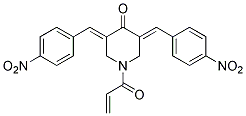
CAS No. 1009817-63-3
文献中Selleckの製品使用例(24)
カスタマーフィードバック1例
製品安全説明書
b-AP15関連製品
シグナル伝達経路
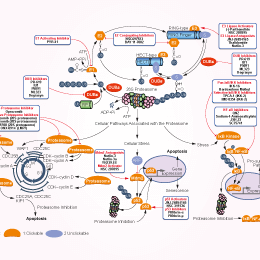
DUB阻害剤の選択性比較
Cell Data
| Cell Lines | Assay Type | Concentration | Incubation Time | 活性情報 | PMID |
|---|---|---|---|---|---|
| P388 cells | Cytotoxicity assay | Cytotoxicity against murine P388 cells, IC50=0.05 μM | |||
| human HSC2 | Cytotoxicity assay | Cytotoxicity against human HSC2 by MTT method, CC50=0.094 μM | |||
| HL60 cells | Cytotoxicity assay | Cytotoxicity against human HL60 cells in presence of RPMI1640 containing 10% fetal bovine serum by trypan blue exclusion test, CC50=0.13 μM | |||
| Molt 4/C8 cells | Cytotoxicity assay | Cytotoxicity against human Molt 4/C8 cells, IC50=0.15 μM | |||
| CEM cells | Cytotoxicity assay | Cytotoxicity against human CEM cells, IC50=0.26 μM | |||
| L1210 cells | Cytotoxicity assay | Cytotoxicity against murine L1210 cells, IC50=0.42 μM | |||
| HSC4 cells | Cytotoxicity assay | Cytotoxicity against human HSC4 cells by MTT method, CC50=0.56 μM | |||
| 他の多くの細胞株試験データをご覧になる場合はこちらをクリックして下さい | |||||
生物活性
| 製品説明 | b-AP15(NSC687852)は、Ub-AMC開裂の19Sプロテアソーム活性を阻害するdeubiquitinases阻害剤であり、IC50は2.1 μMです。 | ||||
|---|---|---|---|---|---|
| 特性 | Not a general deubiquitinase inhibitor. Has minimal inhibition on recombinant and cytosolic nonproteasomal cysteine deubiquitinases. | ||||
| Targets |
|
| In Vitro | ||||
| In vitro | b-AP15 inhibits the activity of two 19S regulatory-particle-associated deubiquitinases, ubiquitin C-terminal hydrolase 5 (UCHL5) and ubiquitin-specific peptidase 14 (USP14), resulting in accumulation of polyubiquitin. This compound results in a dose-dependent accumulation of the UbG76V-YFP reporter with IC50 of 0.8 μM, indicating impaired proteasome degradation. It (1 μM) results in rapid accumulation of polyubiquitinated proteins in human colon carcinoma HCT-116 cells. This chemical (2.2 μM) increases the amounts of the cyclin-dependent kinases CDKN1A and CDKNIB and the tumor suppressor TP53 in a dose-dependent manner without altering the amounts of ornithine decarboxylase 1 (ODC1) in HCT-116 cells. It (1 μM) results in G2/M phase cell-cycle arrest in HCT-116 cells, consistent with the accumulation of cell-cycle inhibitors. This compound treatment increases the number of hypodiploid cells and is associated with increased amounts of apoptotic markers, including activated caspase-3, caspase-cleaved poly-ADP ribose polymerase (PARP) and cytokeratin-18 (CK18). It is more toxic to HCT-116 cells as compared to immortalized epithelial cells (hTERT-RPE1) or peripheral blood mononuclear cells. This inhibitor inhibits deubiquitinating activity using a variety of substrates, including Ub-AMC, Ub-GFP22, ubiquitinated p53-binding protein homolog (HDM2), and K48- and K63-linked ubiquitin tetramer chains. It is an inhibitor of the UPS that induced cell death via induction of the lysosomal apoptosis pathway in a cathepsin-D dependent manner. This compound elicits characteristic UPS defects including the accumulation of ubiquitin conjugates and cell cycle inhibitors such as p21, p27 and the tumor suppressor p53. It inhibits the deubiquitinase activity of both cysteine DUBs, with USP14 being slightly more sensitive than UCHL5. This chemical induces apoptosis in cells over-expressing the anti-apoptotic Bcl-2 protein and in cells lacking the p53 gene. It (1 μM) inhibits ATP-induced IL-1β release from LPS-primed peritoneal macrophages. This compound (1 μM) reduces the levels of cell death induced by nigericin treatment in THP-1 cells. It (1 μM) significantly reduces the numbers of ASC specks formed after nigericin treatment in LPS-primed THP-1 cells. | |||
|---|---|---|---|---|
| In Vivo | ||
| In Vivo | b-AP15 (5 mg/kg) shows significant antitumor activity in severe combined immunodeficiency (SCID) mice with FaDu squamous carcinoma xenografts. This compound significantly delays tumor onset in mice with HCT-116 colon carcinoma xenografts. | |
|---|---|---|
| 動物実験 | 動物モデル | mice with HCT-116 colon carcinoma xenografts |
| 投与量 | 5 mg/kg | |
| 投与経路 | intraperitoneal injection | |
|
化学情報
| 分子量 | 419.39 | 化学式 | C22H17N3O6 |
| CAS No. | 1009817-63-3 | SDF | Download b-AP15 SDFをダウンロードする |
| Smiles | C=CC(=O)N1CC(=CC2=CC=C(C=C2)[N+](=O)[O-])C(=O)C(=CC3=CC=C(C=C3)[N+](=O)[O-])C1 | ||
| 保管 | |||
|
In vitro |
DMSO : 48 mg/mL ( (114.45 mM); 吸湿したDMSOは溶解度を減少させます。新しいDMSOをご使用ください。) Water : Insoluble Ethanol : Insoluble |
モル濃度計算器 |
|
in vivo Add solvents to the product individually and in order. |
投与溶液組成計算機 | |||||
実験計算
投与溶液組成計算機(クリア溶液)
ステップ1:実験データを入力してください。(実験操作によるロスを考慮し、動物数を1匹分多くして計算・調製することを推奨します)
mg/kg
g
μL
匹
ステップ2:投与溶媒の組成を入力してください。(ロット毎に適した溶解組成が異なる場合があります。詳細については弊社までお問い合わせください)
% DMSO
%
% Tween 80
% ddH2O
%DMSO
%
計算結果:
投与溶媒濃度: mg/ml;
DMSOストック溶液調製方法: mg 試薬を μL DMSOに溶解する(濃度 mg/mL, 注:濃度が当該ロットのDMSO溶解度を超える場合はご連絡ください。 )
投与溶媒調製方法:Take μL DMSOストック溶液に μL PEG300,を加え、完全溶解後μL Tween 80,を加えて完全溶解させた後 μL ddH2O,を加え完全に溶解させます。
投与溶媒調製方法:μL DMSOストック溶液に μL Corn oil,を加え、完全溶解。
注意:1.ストック溶液に沈殿、混濁などがないことをご確認ください;
2.順番通りに溶剤を加えてください。次のステップに進む前に溶液に沈殿、混濁などがないことを確認してから加えてください。ボルテックス、ソニケーション、水浴加熱など物理的な方法で溶解を早めることは可能です。
技術サポート
ストックの作り方、阻害剤の保管方法、細胞実験や動物実験の際に注意すべき点など、製品を取扱う時に問い合わせが多かった質問に対しては取扱説明書でお答えしています。
他に質問がある場合は、お気軽にお問い合わせください。
* 必須

納期 国内在庫品:受注日の翌日(15時までの受注分) *北海道、九州、沖縄への配送は受注日より2日以上 を要する場合あり 海外在庫品:受注後1〜2週間