
- 阻害剤
- 研究分野別
- PI3K/Akt/mTOR
- Epigenetics
- Methylation
- Immunology & Inflammation
- Protein Tyrosine Kinase
- Angiogenesis
- Apoptosis
- Autophagy
- ER stress & UPR
- JAK/STAT
- MAPK
- Cytoskeletal Signaling
- Cell Cycle
- TGF-beta/Smad
- 化合物ライブラリー
- 抗体
- 新製品
- お問い合わせ

3-Nitropropionic acid (3-NP)
別名:β-Nitropropionic Acid
3-ニトロプロピオン酸(3-NP)は、ミトコンドリア呼吸複合体IIコハク酸脱水素酵素の不可逆的阻害剤であり、電子伝達系の破壊を通じてエネルギー枯渇を引き起こします。
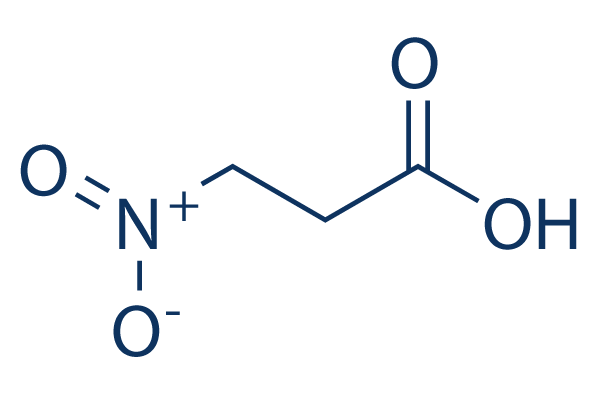
CAS No. 504-88-1
文献中Selleckの製品使用例(3)
製品安全説明書
現在のバッチを見る:
S365203
DMSO]
24 mg/mL]
false]
Water]
24 mg/mL]
false]
Ethanol]
24 mg/mL]
false
純度:
99.04%
99.04
3-Nitropropionic acid (3-NP)関連製品
シグナル伝達経路
Dehydrogenase阻害剤の選択性比較
生物活性
| 製品説明 | 3-ニトロプロピオン酸(3-NP)は、ミトコンドリア呼吸複合体IIコハク酸脱水素酵素の不可逆的阻害剤であり、電子伝達系の破壊を通じてエネルギー枯渇を引き起こします。 | |
|---|---|---|
| Targets |
|
| In Vitro | ||||
| In vitro | 3-nitropropionic acid (3-NPA) is an irreversible inhibitor of complex II in the mitochondria. It impairs cellular energy metabolism via inhibition of succinate dehydrogenase, which induces a reduction in ATP production and leads to oxidative stress. 3-NPA can cause the generation and release of ROS from mitochondria, mitochondrial DNA damage, and thus loss of mitochondrial function. 3-NPA reduces the number of large follicles, impairs oocyte development, and increases the percentage of atretic large follicles and ROS levels in oocytes and granulosa cells. ROS production followed by mitochondrial DNA damage is the primary event in 3-NPA toxicity, and Bcl-2 protects PC12 cells from 3-NPA toxicity by preventing mitochondrial DNA damage. | |||
|---|---|---|---|---|
| 細胞実験 | 細胞株 | PC12 cells | ||
| 濃度 | 4-8 mM | |||
| 反応時間 | 48 h | |||
| 実験の流れ | Viability of the PC12 cells with or without treatment of 3-NPA is estimated using trypan blue exclusion test. Cells are grown in Petri dishes to a density of 1 × 10⁶ cells/dish. After treatment with 4 or 8 mM 3-NPA for 48 h, cells are washed with Hank's balanced salt solution. Trypan blue (0.4 %) is added to the cells and incubated for 5 min. Both viable and nonviable cells are scored on a hemocytometer using a Nikon microscope. The nonviable cells are expressed as a percentage of total cell population | |||
| In Vivo | ||
| In Vivo | 3-NPA induces granulosa cell apoptosis, large follicle atresia, and an increase of ROS levels in the ovary. | |
|---|---|---|
| 動物実験 | 動物モデル | ICR mice |
| 投与量 | 6.25, 12.5 and 25 mg/kg | |
| 投与経路 | i.p. | |
|
化学情報
| 分子量 | 119.08 | 化学式 | C3H5NO4 |
| CAS No. | 504-88-1 | SDF | Download 3-Nitropropionic acid (3-NP) SDFをダウンロードする |
| 保管 | |||
|
In vitro |
DMSO : 24 mg/mL ( (201.54 mM); 吸湿したDMSOは溶解度を減少させます。新しいDMSOをご使用ください。) Water : 24 mg/mL Ethanol : 24 mg/mL |
モル濃度計算器 |
|
in vivo Add solvents to the product individually and in order. |
投与溶液組成計算機 | |||||
実験計算
投与溶液組成計算機(クリア溶液)
ステップ1:実験データを入力してください。(実験操作によるロスを考慮し、動物数を1匹分多くして計算・調製することを推奨します)
mg/kg
g
μL
匹
ステップ2:投与溶媒の組成を入力してください。(ロット毎に適した溶解組成が異なる場合があります。詳細については弊社までお問い合わせください)
% DMSO
%
% Tween 80
% ddH2O
%DMSO
%
計算結果:
投与溶媒濃度: mg/ml;
DMSOストック溶液調製方法: mg 試薬を μL DMSOに溶解する(濃度 mg/mL, 注:濃度が当該ロットのDMSO溶解度を超える場合はご連絡ください。 )
投与溶媒調製方法:Take μL DMSOストック溶液に μL PEG300,を加え、完全溶解後μL Tween 80,を加えて完全溶解させた後 μL ddH2O,を加え完全に溶解させます。
投与溶媒調製方法:μL DMSOストック溶液に μL Corn oil,を加え、完全溶解。
注意:1.ストック溶液に沈殿、混濁などがないことをご確認ください;
2.順番通りに溶剤を加えてください。次のステップに進む前に溶液に沈殿、混濁などがないことを確認してから加えてください。ボルテックス、ソニケーション、水浴加熱など物理的な方法で溶解を早めることは可能です。
技術サポート
ストックの作り方、阻害剤の保管方法、細胞実験や動物実験の際に注意すべき点など、製品を取扱う時に問い合わせが多かった質問に対しては取扱説明書でお答えしています。
他に質問がある場合は、お気軽にお問い合わせください。
* 必須

納期 国内在庫品:受注日の翌日(15時までの受注分) *北海道、九州、沖縄への配送は受注日より2日以上 を要する場合あり 海外在庫品:受注後1〜2週間