
- 阻害剤
- 研究分野別
- PI3K/Akt/mTOR
- Epigenetics
- Methylation
- Immunology & Inflammation
- Protein Tyrosine Kinase
- Angiogenesis
- Apoptosis
- Autophagy
- ER stress & UPR
- JAK/STAT
- MAPK
- Cytoskeletal Signaling
- Cell Cycle
- TGF-beta/Smad
- 化合物ライブラリー
- 抗体
- 新製品
- お問い合わせ

Torkinib (PP242)
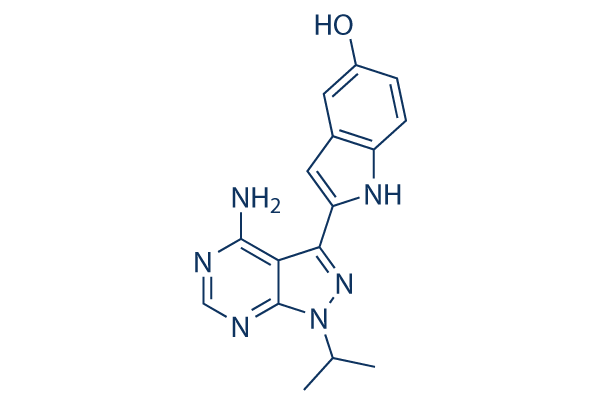
Torkinib (PP242)は、細胞を含まないアッセイでIC50が8 nMの選択的mTOR阻害剤であり、PI3KδまたはPI3Kα/β/γよりもそれぞれ10倍以上および100倍の選択性で両方のmTOR複合体を標的とします。Torkinib (PP242)はmitophagyとapoptosisを誘導します。
CAS No. 1092351-67-1
文献中Selleckの製品使用例(108)
製品安全説明書
現在のバッチを見る:
純度:
99.50%
99.50
Torkinib (PP242)関連製品
シグナル伝達経路
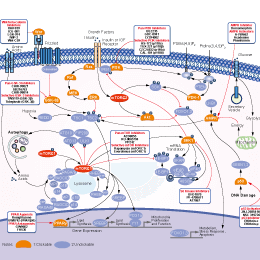
mTOR阻害剤の選択性比較
Cell Data
| Cell Lines | Assay Type | Concentration | Incubation Time | 活性情報 | PMID |
|---|---|---|---|---|---|
| HT-p21 | Function Assay | 50-1250 nM | 24 h | inhibits phosphorylation of S6 kinase (target of mTORC1) and its downstream target phospho-S6 | |
| U87vIII | Function Assay | 0.04-2.5 μM | 24 h | inhibits mTORC1 and mTORC2 activities | |
| U87vIII | Function Assay | 2.5/5 μM | 12 h | inhibits gap closing in a dose-dependent manner | |
| 3T3-L1 | Function Assay | 15 μM | 4 h | suppresses expression of the Egr1 protein | |
| Rh30 | Function Assay | 1 μM | 2 h | inhibits both mTORC1-mediated phosphorylation of S6K1 and mTORC2-mediated phosphorylation of Akt | |
| HT29 | Function Assay | 1 μM | 2 h | inhibits both mTORC1-mediated phosphorylation of S6K1 and mTORC2-mediated phosphorylation of Akt | |
| Rh30 | Function Assay | 1 μM | 2 h | suppresses the basal or IGF-1-stimulated cell adhesion | |
| HT29 | Function Assay | 1 μM | 2 h | suppresses the basal or IGF-1-stimulated cell adhesion | |
| U87 | Growth Inhibition Assay | 25 nM | 24 h | increases DUSP10 knocked-down induced cell inhibition | |
| AGS | Cell Viability Assay | 0-1000 nM | 24/48 h | decreases cell viability in time and dose dependent manner | |
| MKN45 | Cell Viability Assay | 0-1000 nM | 24/48 h | decreases cell viability in time and dose dependent manner | |
| MKN28 | Cell Viability Assay | 0-1000 nM | 24/48 h | decreases cell viability in time and dose dependent manner | |
| KATO3 | Cell Viability Assay | 0-1000 nM | 24/48 h | decreases cell viability in time and dose dependent manner | |
| SGC7901 | Cell Viability Assay | 0-1000 nM | 24/48 h | decreases cell viability in time and dose dependent manner | |
| N87 | Cell Viability Assay | 0-1000 nM | 24/48 h | decreases cell viability in time and dose dependent manner | |
| HMEC | Cell Viability Assay | 0-1000 nM | 24/48 h | decreases cell viability in time and dose dependent manner | |
| HUVEC | Cell Viability Assay | 0-1000 nM | 24/48 h | decreases cell viability in time and dose dependent manner | |
| MG63 | Function Assay | 50-1000 nM | 0.5 h | dose dependently (50–1000 nM) inhibits phosphorylation of Akt | |
| U2OS | Function Assay | 50-1000 nM | 0.5 h | dose dependently (50–1000 nM) inhibits phosphorylation of Akt | |
| Saos-2 | Function Assay | 50-1000 nM | 0.5 h | dose dependently (50–1000 nM) inhibits phosphorylation of Akt | |
| Saos-2 | Function Assay | 100 nM | 0.5 h | prevents osteosarcoma cell migration | |
| MG63 | Apoptosis Assay | 100 nM | 36 h | promotes apoptosis | |
| U2OS | Apoptosis Assay | 100 nM | 36 h | promotes apoptosis | |
| Saos-2 | Apoptosis Assay | 100 nM | 36 h | promotes apoptosis | |
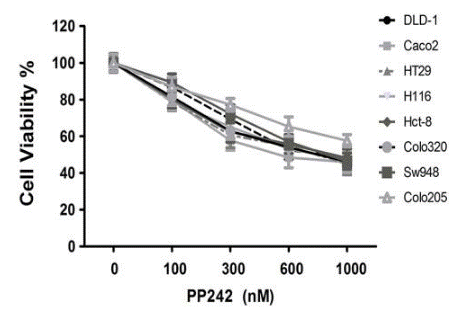
| DLD-1 | Cell Viability Assay | 0-1000 nM | 24 h | inhibits the growth in a dose-dependent manner | |
| Caco2 | Cell Viability Assay | 0-1000 nM | 24 h | inhibits the growth in a dose-dependent manner | |
| HT29 | Cell Viability Assay | 0-1000 nM | 24 h | inhibits the growth in a dose-dependent manner | |
| H116 | Cell Viability Assay | 0-1000 nM | 24 h | inhibits the growth in a dose-dependent manner | |
| Hct-8 | Cell Viability Assay | 0-1000 nM | 24 h | inhibits the growth in a dose-dependent manner | |
| Colo320 | Cell Viability Assay | 0-1000 nM | 24 h | inhibits the growth in a dose-dependent manner | |
| Sw948 | Cell Viability Assay | 0-1000 nM | 24 h | inhibits the growth in a dose-dependent manner | |
| Colo205 | Cell Viability Assay | 0-1000 nM | 24 h | inhibits the growth in a dose-dependent manner | |
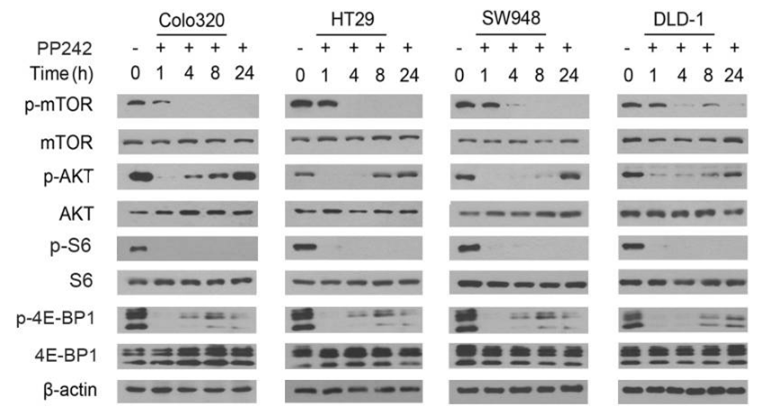
| Colo320 | Function Assay | 1 μM | 0-24 h | abolishes the S6S235/236 but partially reduces the 4E-BP1T36/45 | |
| HT29 | Function Assay | 1 μM | 0-24 h | abolishes the S6S235/236 but partially reduces the 4E-BP1T36/45 | |
| Sw948 | Function Assay | 1 μM | 0-24 h | abolishes the S6S235/236 but partially reduces the 4E-BP1T36/45 | |
| DLD-1 | Function Assay | 1 μM | 0-24 h | abolishes the S6S235/236 but partially reduces the 4E-BP1T36/45 | |
| 786-O | Function Assay | 0.1/0.5 μM | 24 h | increases E-cadherin mRNA levels dose dependently | |
| 786-O | Function Assay | 0-0.5 μM | 24 h | results in a dose dependent increase in E-cadherin protein expression | |
| OCI-AML3 | Apoptosis Assay | 2.5 μM | 72 h | induces apoptosis | |
| Jurkat | Function Assay | 100/200/400 nM | 18 h | inhibits mTORC1-dependent S6 S235/236 phosphorylation | |
| p210 BCR-Abl | Function Assay | 100/200/400 nM | 18 h | inhibits mTORC1-dependent S6 S235/236 phosphorylation | |
| Jurkat | Growth Inhibition Assay | 400nM | 24/48 h | synergize with 17-AAG to suppress cell proliferation | |
| p210 BCR-Abl | Growth Inhibition Assay | 400nM | 24/48 h | synergize with 17-AAG to suppress cell proliferation | |
| 8226 | Function Assay | 100-1000 nM | 30 min | activates ERK | |
| MM1.S | Function Assay | 100-1000 nM | 30 min | activates ERK | |
| 8226 | Function Assay | 0.5 μM | 30 min | induces activation of RAF and phosphorylation of MEK | |
| MM1.S | Function Assay | 0.5 μM | 30 min | induces activation of RAF and phosphorylation of MEK | |
| MCF-7 | Function Assay | 50/200/500 nM | 30 min | dose-dependently (50–500 nM) suppresses phosphorylation of Akt | |
| T47D | Function Assay | 50/200/500 nM | 30 min | dose-dependently (50–500 nM) suppresses phosphorylation of Akt | |
| MDA-MB-231 | Function Assay | 50/200/500 nM | 30 min | dose-dependently (50–500 nM) suppresses phosphorylation of Akt | |
| Bcap-37 | Function Assay | 50/200/500 nM | 30 min | dose-dependently (50–500 nM) suppresses phosphorylation of Akt | |
| MCF-7 | Apoptosis Assay | 200 nM | 36 h | induces apoptosis | |
| MDA-MB-231 | Apoptosis Assay | 200 nM | 36 h | induces apoptosis | |
| Bcap-37 | Apoptosis Assay | 200 nM | 36 h | induces apoptosis | |
| LS174T | Function Assay | 10/100/1000 nM | 6 h | inhibits mTORC1 activity by the dephosphorylation of S6 ribosomal protein | |
| DLD-1 | Function Assay | 10/100/1000 nM | 6 h | inhibits mTORC1 activity by the dephosphorylation of S6 ribosomal protein | |
| SW480 | Function Assay | 10/100/1000 nM | 6 h | inhibits mTORC1 activity by the dephosphorylation of S6 ribosomal protein | |
| NIH 3T3 | Function Assay | 2 μM | 18 h | inhibits mTORC2 phosphorylation of Akt on Ser473 and mTORC1 phosphorylation of 4E-BP1 on Thr37/46 | |
| HCT15 | Function Assay | 0.5/2 μM | 4 h | prevents S6K1 phosphorylation of ribosomal protein S6 at Ser240/244 and mTORC2 phosphorylation of Akt at Ser473 | |
| SW620 | Function Assay | 0.5/2 μM | 4 h | blocks all three mTOR outputs | |
| PC12 | Function Assay | 40 nM | induces lysosomal biogenesis and alleviated α-SYN accumulation | ||
| DND-1 | Growth Inhibition Assay | 0.25/0.5/1 μM | inhibits cell growth dose dependently | ||
| TMD8 | Growth Inhibition Assay | 0.25/0.5/1 μM | inhibits cell growth dose dependently | ||
| Jurkat | Growth Inhibition Assay | 0.25/0.5/1 μM | inhibits cell growth dose dependently | ||
| KOPT-K1 | Growth Inhibition Assay | 0.25/0.5/1 μM | inhibits cell growth dose dependently | ||
| TMD7 | Growth Inhibition Assay | 0.25/0.5/1 μM | inhibits cell growth dose dependently | ||
| THP-1 | Growth Inhibition Assay | 0.25/0.5/1 μM | inhibits cell growth dose dependently | ||
| HT1376 | Growth Inhibition Assay | IC50=1.88 ± 1.1 μM | |||
| T24 | Growth Inhibition Assay | IC50=1.37 ± 0.4 μM | |||
| UM-UC-3 | Growth Inhibition Assay | IC50=0.63 ±0.1 μM | |||
| SW620 | Growth Inhibition Assay | IC50=7.8 μM | |||
| SW480 | Growth Inhibition Assay | IC50=4.6 μM | |||
| SK-CO-1 | Growth Inhibition Assay | IC50=4 μM | |||
| LS-513 | Growth Inhibition Assay | IC50=3.9 μM | |||
| SW1116 | Growth Inhibition Assay | IC50=0.84 μM | |||
| LS-174T | Growth Inhibition Assay | IC50=0.84 μM | |||
| HCT 116 | Growth Inhibition Assay | IC50=0.41 μM | |||
| HCT 15 | Growth Inhibition Assay | IC50=0.3 μM | |||
| COLO 205 | Growth Inhibition Assay | IC50=0.24 μM | |||
| HT-29 | Growth Inhibition Assay | IC50=0.23 μM | |||
| COLO 201 | Growth Inhibition Assay | IC50=0.23 μM | |||
| Caco-2 | Growth Inhibition Assay | IC50=0.22 μM | |||
| SW48 | Growth Inhibition Assay | IC50=0.09 μM | |||
| SW-48 | Growth Inhibition Assay | IC50=0.1 μM | |||
| HCT-15 | Growth Inhibition Assay | IC50=0.3 μM | |||
| HCT 116 | Growth Inhibition Assay | IC50=0.6 μM | |||
| SW620-R | Growth Inhibition Assay | IC50=1.3 μM | |||
| SK-CO-1 | Growth Inhibition Assay | IC50=2.1 μM | |||
| SW620 | Growth Inhibition Assay | IC50=11 μM | |||
| BaF3 | Growth Inhibition Assay | GI50=1.449 μM | |||
| 他の多くの細胞株試験データをご覧になる場合はこちらをクリックして下さい | |||||
生物活性
| 製品説明 | Torkinib (PP242)は、細胞を含まないアッセイでIC50が8 nMの選択的mTOR阻害剤であり、PI3KδまたはPI3Kα/β/γよりもそれぞれ10倍以上および100倍の選択性で両方のmTOR複合体を標的とします。Torkinib (PP242)はmitophagyとapoptosisを誘導します。 | ||||||||
|---|---|---|---|---|---|---|---|---|---|
| 特性 | One of the first selective inhibitors that targets ATP domain of mTOR. | ||||||||
| Targets |
|
| In Vitro | ||||
| In vitro | PP242 exhibits potent selectivity for mTOR over other PI3K family kinases such as p110α, p110β, p110γ, p110δ, and DNA-PK with IC50 of 1.96 μM, 2.2 μM, 1.27 μM, 0.102 μM, and 0.408 μM, respectively. This compound displays some inhibitory activity against Ret, PKCα, PKCβ, and JAK2, while exhibits remarkable selectivity against 215 other protein kinases. Unlike rapamycin, this inhibitor inhibits both mTORC1 and mTORC2. In BT549 cells, this chemical treatment (0.04-10 μM) inhibits the phosphorylation of Akt, the mTOR substrate p70S6K, and its downstream target S6 in a dose-dependent manner. It potently inhibits PKCα with IC50 of 49 nM. Low concentrations of this compound inhibit the phosphorylation of Akt S473 and higher concentrations partially inhibit Akt T308-P in addition to S473-P. As this agent is a more effective mTORC1 inhibitor than rapamycin, it inhibits the proliferation of primary MEFs, and the phosphorylation of 4EBP1 at T36/45 and S65, more potently than rapamycin. This compound but not rapamycin potently inhibits cap-dependent translation, by causing a higher level of binding between 4EBP1 and eIF4E than rapamycin. It potently inhibits the proliferation of p190-transformed murine BM, SUP-B15, and K562 cells with GI50 of 12 nM, 90 nM, and 85 nM, respectively. This inhibitor also inhibits the growth of solid tumor cell lines such as SKOV3, PC3, 786-O, and U87 with GI50 of 0.49 μM, 0.19 μM, 2.13 μM, and 1.57 μM, respectively. It is also more effective than rapamycin in achieving cytoreduction and apoptosis in multiple myeloma (MM) cells. | |||
|---|---|---|---|---|
| Kinase Assay | In vitro mTOR (FRAP1) kinase assay | |||
| Recombinant mTOR is incubated with this compound at 2-fold dilutions over a concentration range of 50-0.001 μM in an assay containing 50 mM HEPES, pH 7.5, 1 mM EGTA, 10 mM MgCl2, 0.01% Tween, 10 μM ATP (2.5 μCi of γ-32P-ATP), and 3 μg/mL BSA. Rat recombinant PHAS-1/4EBP1 (2 mg/mL) is used as a substrate. Reactions are terminated by spotting onto nitrocellulose, which is washed with 1 M NaCl/1% phosphoric acid (approximately 6 times, 5-10 minutes each). Sheets are dried and the transferred radioactivity quantitated by phosphorimaging. IC50 value is calculated by fitting the data to a sigmoidal dose-response curve using the Prism software package. | ||||
| 細胞実験 | 細胞株 | MEFs | ||
| 濃度 | Dissolved in DMSO, final concentrations ~10 μM | |||
| 反応時間 | 72 hours | |||
| 実験の流れ | Cells are treated with increasing concentrations of this compound for 72 hours in 96-well plates. After 72 hours of treatment, 10 μL of 440 μM resazurin sodium salt is added to each well, and after 18 hours, the florescence intensity in each well is measured using a top-reading florescent plate reader with excitation at 530 nm and emission at 590 nm. | |||
| 実験結果図 | Methods | Biomarkers | 結果図 | PMID |
| Western blot | p-mTOR / mTOR / p-AKT / AKT / p-S6 / S6 / p-4E-BP1 / 4E-BP-1 |
|
23991179 | |
| Growth inhibition assay | Cell viability |
|
23991179 | |
| In Vivo | ||
| In Vivo | Administration of PP242 is able to completely inhibit the phosphorylation of Akt at S473 and T308 in fat and liver of mice. This compound only partially inhibits the phosphorylation of Akt in skeletal muscle and is more effective at inhibiting the phosphorylation of T308 than S473, despite able to fully inhibit the phosphorylation of 4EBP1 and S6. Oral administration of this chemical potently delays the leukemia onset in the mice model, and induces leukemia regression by inhibiting mTORC2 and mTORC1 activation that correlates with loss in cell size. This treatment potently inhibits the growth of 8226 cells in mice. | |
|---|---|---|
| 動物実験 | 動物モデル | Syngeneic (Balbc/J) mice with mouse p190-transformed BM cells to initiate leukemia, and female NSG mice injected (i.v.) with SUP-B15ffLuc cells or human Ph+ leukemia |
| 投与量 | ~60 mg/kg/day | |
| 投与経路 | Oral gavage | |
|
化学情報
| 分子量 | 308.34 | 化学式 | C16H16N6O |
| CAS No. | 1092351-67-1 | SDF | Download Torkinib (PP242) SDFをダウンロードする |
| Smiles | CC(C)N1C2=NC=NC(=C2C(=N1)C3=CC4=C(N3)C=CC(=C4)O)N | ||
| 保管 | |||
|
In vitro |
DMSO : 61 mg/mL ( (197.83 mM); 吸湿したDMSOは溶解度を減少させます。新しいDMSOをご使用ください。) Water : Insoluble Ethanol : Insoluble |
モル濃度計算器 |
|
in vivo Add solvents to the product individually and in order. |
投与溶液組成計算機 | |||||
実験計算
投与溶液組成計算機(クリア溶液)
ステップ1:実験データを入力してください。(実験操作によるロスを考慮し、動物数を1匹分多くして計算・調製することを推奨します)
mg/kg
g
μL
匹
ステップ2:投与溶媒の組成を入力してください。(ロット毎に適した溶解組成が異なる場合があります。詳細については弊社までお問い合わせください)
% DMSO
%
% Tween 80
% ddH2O
%DMSO
%
計算結果:
投与溶媒濃度: mg/ml;
DMSOストック溶液調製方法: mg 試薬を μL DMSOに溶解する(濃度 mg/mL, 注:濃度が当該ロットのDMSO溶解度を超える場合はご連絡ください。 )
投与溶媒調製方法:Take μL DMSOストック溶液に μL PEG300,を加え、完全溶解後μL Tween 80,を加えて完全溶解させた後 μL ddH2O,を加え完全に溶解させます。
投与溶媒調製方法:μL DMSOストック溶液に μL Corn oil,を加え、完全溶解。
注意:1.ストック溶液に沈殿、混濁などがないことをご確認ください;
2.順番通りに溶剤を加えてください。次のステップに進む前に溶液に沈殿、混濁などがないことを確認してから加えてください。ボルテックス、ソニケーション、水浴加熱など物理的な方法で溶解を早めることは可能です。
技術サポート
ストックの作り方、阻害剤の保管方法、細胞実験や動物実験の際に注意すべき点など、製品を取扱う時に問い合わせが多かった質問に対しては取扱説明書でお答えしています。
他に質問がある場合は、お気軽にお問い合わせください。
* 必須
よくある質問(FAQ)
質問1:
Do you have any suggestions about potential candidates for vehicles that we could use for in vivo studies of it?
回答
In the recommended solvent (30% PEG400 + 0.5% Tween80 + 5% Propylene glycol), it is a suspension, and this formulation is for oral gavage. For IV injection, this compound can be dissolved in 2% DMSO+30% PEG 300+5% Tween 80+ddH2O at 5mg/ml as a clear solution.

納期 国内在庫品:受注日の翌日(15時までの受注分) *北海道、九州、沖縄への配送は受注日より2日以上 を要する場合あり 海外在庫品:受注後1〜2週間