
- 阻害剤
- 研究分野別
- PI3K/Akt/mTOR
- Epigenetics
- Methylation
- Immunology & Inflammation
- Protein Tyrosine Kinase
- Angiogenesis
- Apoptosis
- Autophagy
- ER stress & UPR
- JAK/STAT
- MAPK
- Cytoskeletal Signaling
- Cell Cycle
- TGF-beta/Smad
- 化合物ライブラリー
- 抗体
- 新製品
- お問い合わせ

Ziprasidone HCl
別名:CP-88059
Ziprasidone HCl(CP-88059)は、新規で強力なdopamine およびserotonin (5-HT) receptor アンタゴニストであり、統合失調症や双極性障害の治療に用いられます。
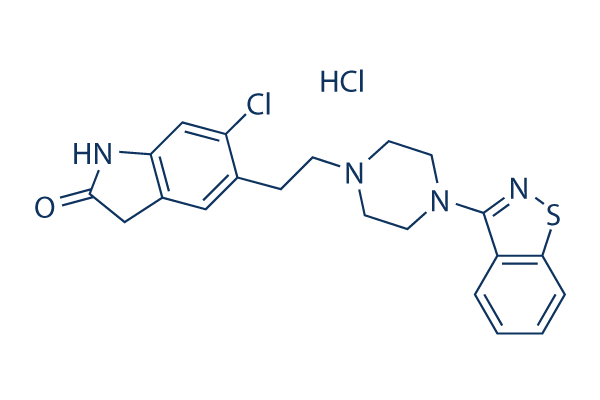
CAS No. 122883-93-6
文献中Selleckの製品使用例(6)
カスタマーフィードバック1例
製品安全説明書
Ziprasidone HCl関連製品
シグナル伝達経路
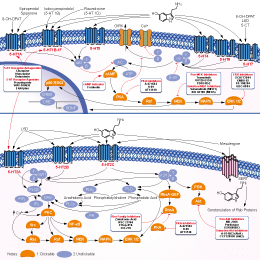
5-HT Receptor阻害剤の選択性比較
生物活性
| 製品説明 | Ziprasidone HCl(CP-88059)は、新規で強力なdopamine およびserotonin (5-HT) receptor アンタゴニストであり、統合失調症や双極性障害の治療に用いられます。 | ||
|---|---|---|---|
| Targets |
|
| In Vitro | ||||
| In vitro | Ziprasidone has high affinity for human 5-HT receptors and for human dopamine D(2) receptors. Ziprasidone is a 5-HT(1A) receptor agonist and an antagonist at 5-HT(2A), 5-HT(2C) and 5-HT(1B/1D) receptors. Ziprasidone inhibits neuronal uptake of 5-HT and norepinephrine comparable to the antidepressant imipramine. Ziprasidone blocks wild-type hERG current in a voltage- and concentration-dependent manner with IC(50) of 120nM in stably transfected HEK-293 cells. Ziprasidone shows minimal tonic block of hERG current estimated during a depolarizing voltage (-20 or +30mV) or evaluated by the envelope of tails test (+30mV). Ziprasidone significantly increases the time constant of the slow component of hERG current deactivation (at -50mV). | |||
|---|---|---|---|---|
| In Vivo | ||
| In Vivo | Ziprasidone exhibits less potent block of wild-type hERG current with IC(50) of 2.8 mM in Xenopus oocytes. Ziprasidone suppresses the significant increases in food intake produced by olanzapine, indicating that it has an intrinsic protective mechanism against drug-induced increases in food intake in rats. Ziprasidone results in a notable increase in NGF and ChAT immunoreactivity in the dentate gyrus (DG), CA1, and CA3 areas of the hippocampus of rats. Ziprasidone dose-dependently slows raphe unit activity (ED50 = 300 mg/kg i.v.) as does the atypical antipsychotics clozapine (ED50 = 250 mg/kg i.v.) and olanzapine (ED50 = 1000 mg/kg i.v.) in anesthetized rats. | |
|---|---|---|
| NCT Number | Recruitment | Conditions | Sponsor/Collaborators | Start Date | Phases |
|---|---|---|---|---|---|
| NCT03781115 | ACTIVE_NOT_RECRUITING | Schizophrenia |
University of Arizona |
2017-11-20 | PHASE1 |
| NCT04446234 | UNKNOWN | Schizophrenia |
Shanghai Mental Health Center |
2021-05 | PHASE4 |
| NCT03837860 | TERMINATED | Opioid Abuse, Unspecified; Opioid Dependence |
The University of Texas Health Science Center at San Antonio |
2019-04-01 | EARLY_PHASE1 |
| NCT03768726 | TERMINATED | Bipolar Disorder |
Pfizer's Upjohn has merged with Mylan to form Viatris Inc. |
2018-12-21 | PHASE3 |
| NCT02075047 | TERMINATED | Bipolar Disorder |
Pfizer's Upjohn has merged with Mylan to form Viatris Inc. |
2014-05-23 | PHASE3 |
| NCT03011645 | TERMINATED | Cardiovascular Diseases |
Duke University |
2018-05-24 | PHASE1 |
|
化学情報
| 分子量 | 449.4 | 化学式 | C21H21ClN4OS·HCl |
| CAS No. | 122883-93-6 | SDF | Download Ziprasidone HCl SDFをダウンロードする |
| Smiles | C1CN(CCN1CCC2=C(C=C3C(=C2)CC(=O)N3)Cl)C4=NSC5=CC=CC=C54.Cl | ||
| 保管 | |||
|
In vitro |
DMSO : 90 mg/mL ( (200.26 mM); 吸湿したDMSOは溶解度を減少させます。新しいDMSOをご使用ください。) Water : Insoluble Ethanol : Insoluble |
モル濃度計算器 |
|
in vivo Add solvents to the product individually and in order. |
投与溶液組成計算機 | |||||
実験計算
投与溶液組成計算機(クリア溶液)
ステップ1:実験データを入力してください。(実験操作によるロスを考慮し、動物数を1匹分多くして計算・調製することを推奨します)
mg/kg
g
μL
匹
ステップ2:投与溶媒の組成を入力してください。(ロット毎に適した溶解組成が異なる場合があります。詳細については弊社までお問い合わせください)
% DMSO
%
% Tween 80
% ddH2O
%DMSO
%
計算結果:
投与溶媒濃度: mg/ml;
DMSOストック溶液調製方法: mg 試薬を μL DMSOに溶解する(濃度 mg/mL, 注:濃度が当該ロットのDMSO溶解度を超える場合はご連絡ください。 )
投与溶媒調製方法:Take μL DMSOストック溶液に μL PEG300,を加え、完全溶解後μL Tween 80,を加えて完全溶解させた後 μL ddH2O,を加え完全に溶解させます。
投与溶媒調製方法:μL DMSOストック溶液に μL Corn oil,を加え、完全溶解。
注意:1.ストック溶液に沈殿、混濁などがないことをご確認ください;
2.順番通りに溶剤を加えてください。次のステップに進む前に溶液に沈殿、混濁などがないことを確認してから加えてください。ボルテックス、ソニケーション、水浴加熱など物理的な方法で溶解を早めることは可能です。
技術サポート
ストックの作り方、阻害剤の保管方法、細胞実験や動物実験の際に注意すべき点など、製品を取扱う時に問い合わせが多かった質問に対しては取扱説明書でお答えしています。
他に質問がある場合は、お気軽にお問い合わせください。
* 必須

納期 国内在庫品:受注日の翌日(15時までの受注分) *北海道、九州、沖縄への配送は受注日より2日以上 を要する場合あり 海外在庫品:受注後1〜2週間